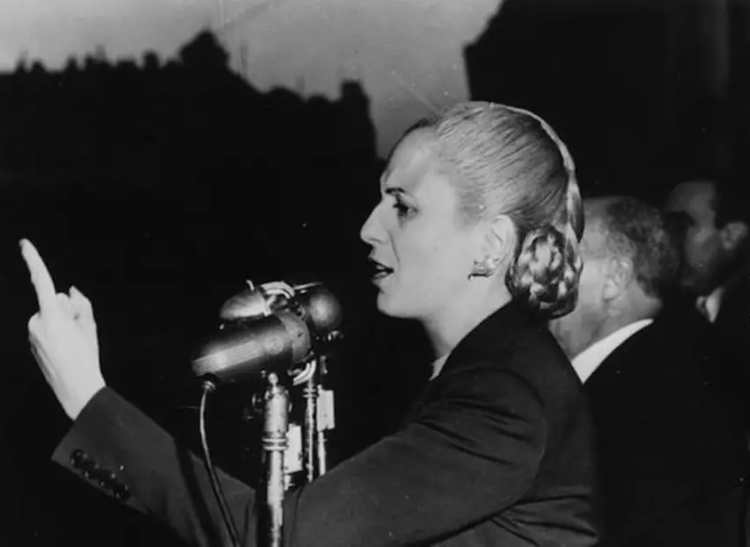
The beautiful Evita Perón wielded amazing power in a time and country when few women broke the patriarchy barrier. Maria Eva de Perón was the 2nd wife of Argentinian President Juan Perón. She was the First Lady of Argentina from 1946, until her very early death at only 33. Popularized in a Broadway musical, she was so much more than just a character. She used her position to fight for women’s rights, improve the lives of the poor, and became a legend in Argentina. A gifted speaker and tireless advocate, she dedicated her short life to making her county better for the marginalized. They responded back by loving her deeply.
So who was this amazing woman? Evita was born María Eva Duarte in 1919. Her father, Juan Duarte, had 2 families – one with his legal wife, and another with his mistress, Juana Ibarguren. María Eva was the 5th baby born to the mistress. While the couple never married, Juana used the name Duarte for herself and her children. The father eventually abandoned both his mistress and his children, leaving them with nothing. He died in a car crash when Eva was only six.
His legal wife rejected Juana and her family at the funeral church. The legitimate family then blocked any inheritance for las ilegítimas. Already struggling to live, this meant even greater hardship. They moved to Junín, a city near Buenos Aires in 1930. Eva’s mother took in boarders and worked long hours as a seamstress. Young Eva dreamed of leaving Junin and becoming an actress. She and her sister often made up their own performances and Eva had a small role in a school play.
At only 15, Eva ran off to Buenos Aires with a young musician to seek a better life.
Both attractive and charming, Eva quickly found work as a model and actress in 1935 at only 16. She landed small roles in theaters and low-budget movies. Later, she found steady work lending her voice to radio dramas. Young Eva played each part with gusto and became popular among Radio el Mundo listeners. She was able to earn enough by the early 1940’s to have her own apartment in an exclusive neighborhood, unheard of for an unmarried Argentinian woman.
When Eva was about 20, she boldly started her own entertainment business, the Company of the Theater of the Air, producing radio programs. In 1943, Eva portrayed a number of famous historical women on a special radio series, Great Women of History. She had a chance to play the likes of Catherine the Great and Queen Elizabeth I. The once poor, illegitimate Eva Duarte soon became a famous personality in Buenos Aires!
In 1944, Eva met someone who would change her life, Colonel Juan Perón.
The widower was a rising political figure in Argentina. Just a year earlier, he’d been one of the officers who overthrew the civilian government in a military coup. The new president made Perón Minister of Labor, where he began improving the rights of poor farm workers. Eva met him at a fundraiser for earthquake victims and they fell instantly in love. He was 48, she was 24.
Part of their romance came from the fact they saw eye-to-eye politically. They were both passionate about helping the marginalized, the Descamisados,or ‘The Shirtless Ones,’ to get their fair share. She was now president of the Broadcast Performers Union and used a daily radio program, Hacia un Futuro Mejor, to promote Perón.
I am only a sparrow amongst a great flock of sparrows.
Eva Peron
In 1945, rival military officers threw Juan in jail, his rising popularity seen as a threat. A few days later, hundreds of thousands of union workers flooded the Plaza de Mayo demanding his release. Eva had roused the people by speaking in person to the largest unions. October 17th, the day he was released, is still celebrated as “El Día de la Lealtad” or the Day of Loyalty.
By then, the two had moved in together in an opulent mansion in Buenos Aires. Living with a much younger, unmarried woman caused problems for Perón (it was the 1940’s after all). So less than a week after his release, Eva and Juan were formally married in a civil ceremony, and later in a church in La Plata.
Eva ‘Evita’ Peron giving a speech in Buenos Aires, Argentina
Rising in popularity, Perón decided to run for president. Eva campaigned tirelessly for her new husband, both on her radio shows and on the campaign. She often appeared with him at public engagements, unprecedented for an Argentinian woman. She appealed directly to the disenfranchised in Argentina, saying she knew their plight because: Soy uno de ustedes!(I am one of you). The public began referring to her lovingly as simply “Evita!”
Juan Perón won the presidential election with a 52% majority.
Evita proved to be a powerful influence as First Lady, fighting for women’s suffrage and to improve the lives of the poor. She kept her promise to the working class. In everything but title, she effectively ran the Ministry of Labor, supporting higher wages and social welfare benefits. Evita kept a high public profile, visiting factories and hospitals, and holding dozens of union meetings. She even toured Europe to raise support for her husband’s administration internationally.
But she was not without critics and detractors. Evita angered the wealthy elite with her campaign for the female vote. Suffrage for women was finally enacted in Argentina, largely due to the energy that Evita poured into the campaign.
Like every woman of the people, I have more strength than I appear to have.
Eva Peron
Not long after the election, the National Congress passed Argentine Law #13,010 in 1947, finally granting women the right to vote. But it did not pass without a hard fight by Eva. All around the nation, women thanked Evita for their right to vote. And she wasted no time in founding the Female Peronist Party. Argentine women registered and voted in droves.
Since the 18oo’s, charitable works in Buenos Aires had been carried out by the Society of Beneficence, a group of wealthy, older ladies. Traditionally, the First Lady was the head of the Society, but in 1946, they snubbed young Evita. She was livid! Evita basically crushed the society by removing their government funding, then starting her own foundation:
The Eva Perón Foundation
In 1948, she established the Eva Perón Foundation – with its first 10,000 pesos coming from her own money. The Foundation provided unprecedented relief for Argentina’s poor, giving away thousands of shoes and sewing machines annually. It provided pensions for the elderly, homes for the poor, schools and libraries in Buenos Aires. The unions and wealthy, looking for political favor, lined up to donate.
Eva personally oversaw it, working tirelessly to raise money, meet with the poor AND listen to their stories. Having once been in poverty herself, Evita understood their lives. Even as her health began to deteriorate, Evita continued to work daily at the Foundation, ignoring the pleas of her doctors and husband to rest. That year, she’d been diagnosed with advanced cervical cancer. She initially kept the diagnosis a secret from her husband.
Juan Perón was coming up for re-election in 1952.
In 1951, he had to select a running mate and he wanted it to be Evita. The working class was overwhelmingly in favor of Evita as VP. Even Juan was surprised at the popularity of his wife, showing him just how important she had become to his own political future. The military and upper classes however were would not accept an ‘illegitimate actress‘ running the country if her husband died.
Eva ‘Evita’ Peron on the cover of TIME magazine
At a summer rally in 1951, hundreds of thousands chanted her name. “EVITA! EVITA! EVITA!” She bowed out, however, telling her adoring masses that her only ambitions wereto serve the poor and her husband. In reality, her decision was probably due to a combination of military pressure and her own failing health. Evita’s new female voting bloc re-elected Juan Perón with a landslide 63% of the vote.
Aggressive treatment of her cervical cancer, including a hysterectomy in New York City, could not halt its advance. In May 1952, on Evita’s 33rd birthday, Juan Peron gave her the title, Líder Espiritual de la Nación (Spiritual Leader of the Nation). Evita made her last public appearance in June 1952, at her husband’s second inauguration. She was so weak, she was unable to stand without support. Everyone knew the end was near – Evita did not deny it.
A month after the reelection, she died in July 1952 at the age of 33.
The public’s grief was overwhelming and unprecedented. Argentina went into mourning unlike any seen since the days of Spanish kings. People piled flowers high on the streets, Argentinians crowded around the presidential palace. The nation gave her a funeral fit for a head of state. A devastated Perón planned an elaborate monument, but it was never completed before he lost power. Evita is buried in the Recoleta Cemetery in Buenos Aires.
Without Evita, another coup removed Juan Perón from power in 3 years, fleeing to Spain. Her final legacy is still hotly debated as both her supporters and enemies wrote her legacy. Peronism is still a powerful political movement in Argentina. Evita is considered a saint by the poor that adored her. She‘s appeared on stamps and coins. There are hundreds of schools and hospitals named after her. Every year, thousands visit her tomb in Recoleta. Her husband Juan died of a heart attack in 1974 at 78.
Evita Peron has been immortalized in countless books, movies, poems, and paintings. Perhaps the most well-known is the 1978 Tony Award winning musical Evita, written by Andrew Lloyd Webber and Tim Rice. It later inspired a 1996 movie starring the singer Madonna as Evita and Jonathan Pryce as Juan. Her leadership and dedication to the poor has served as an inspiration for millions of women around the globe. Her legend only continues to grow.
For more by historical writer Paul Andrews, click on BOOKS
We rarely think of “Genocide” as a modern event. It’s what happened to the Armenians in World War I at the hands of the Turks, and the Jewish Holocaust in World War II at the hands of the Nazis. But the Rwanda Genocide happened just 25 years ago. In 1994, in just 100 gruesome days, nearly 1,000,000 Rwandans were slaughtered by ethnic Hutu extremists. They targeted the minority Tutsi community, as well as any unlucky sympathizers in the East African nation.
Instigated by Hutu nationalists in the capital of Kigali, the genocide spread through the country like a wildfire, with shocking brutality. “Hutu Power” militias incited ordinary citizens to take up arms against their own Tutsi neighbors. By the time the Rwanda Patriotic Front (RPF) finally managed to gain control of the country in July, nearly a million Rwandans laid dead. 2 Million Hutu, now refugees, had fled the country.
How could genocide have happened in modern times?
Rwanda is a small, central African nation, about the size of Denmark, located just south of the Equator. Its neighbors are the Democratic Republic of Congo to the west, Uganda to the north, Tanzania to the east, and Burundi to the south. In 1994, the population was about 7 million, 85 percent the Hutu ethnic group and 15 percent the Tutsi minority. It was also one of the most densely populated countries in all of Africa and also one of the most volatile.
In 1918 after World War I, the League of Nations made Rwanda a Belgium Trusteeship. During this colonial period, the Belgians favored the educated Tutsi minority over the Hutus, causing decades of deep seated resentment. A Hutu nationalist revolution in 1959 forced over 300,000 Tutsis to flee to neighboring countries, making them an even smaller minority in Rwanda. After a United Nations referendum, Belgium finally granted Rwanda independence in 1962.
Ethnic and class violence continued in Rwanda, even following independence. The Tutsis in Rwanda were now discriminated against as inferior people by the new Hutu-controlled government. Ironically, they all were black, spoke the same Bantu language, and practiced the same Christian religions, established while they were a Belgian colony.
The Belgians had instituted identity cards, clearly stating one’s ethnic group.
In 1973, a military coup placed Hutu General Juvenal Habyarimana, in power. He was the sole leader of Rwanda for the next 20 years. Habyarimana founded the National Revolutionary Movement for Development (NRMD) party. He was easily reelected in 1983 and 1988 as Habyarimana made sure he was the only candidate on the ballot.
In 1990, the Rwanda Patriotic Front (RPF), consisting of armed Tutsi rebels, invaded from Uganda, causing a two year civil war. A ceasefire in 1992 led to negotiations between the NRMD and the RPF. Just a year before the genocide, Habyarimana agreed to a new government that would include the RPF. The United Nations established the Assistance Mission for Rwanda (UNAMIR) to assist in the implementation.
Map of Rwanda in Africa surrounded by its neighbors.
This compromise only infuriated Hutu extremists.Coupled with decades of discrimination and hatred, it lit the fuse of genocide. On April 6, 1994, a plane carrying General Habyarimana was shot down over Kigali, leaving no survivors. Who were the culprits?Hutu extremists quickly blamed the RPF and immediately started a campaign of killing Tutsis in Kigali. The RPF blamed the Hutus, saying they shot down the plane to provide an excuse for the killings.
Within an hour of the crash, Hutu members of the Rwandan Armed Forces (FAR) and 2 Hutu militia groups, the Interahamwe and Impuzamugambi, set up armed barricades throughout the capital Kigali. They then started killing Tutsis … and moderate , sympathetic Hutus. The next day, the Hutu military assassinated moderate Hutu Prime Minister Uwilingiyimana and 10 Belgian Peacekeepers. This left a huge political vacuum, into which extremist “Hutu Power” militia leaders quickly stepped in.
The killing of UN Peacekeepers provoked Belgium to withdraw nearly all its UN troops.
From an international standpoint, Rwandan was now on its own. The mass killings in Kigali by Hutus quickly spread into a wholescale slaughter of Tutsi civilians in the countryside. Armed by the NRMD, the Interahamwe,young ‘Hutu Power’ men, were the blood-thirsty maniacs behind the genocide. Those ID cards had people’s ethnic group stamped on them, so it was all too easy.
Hutu extremists set up a radio station, Radio Télévision Libre des Mille Collines (RTLM), which broadcast daily hate propaganda, urging Hutus to “Squash the (Tutsi) Cockroaches.” The names of prominent Tutsis, and Hutu sympathizers, to be killed were read out loud. Radio commentators reminded the Hutus of the discrimination they suffered under the elite Tutsis. They called on all Hutu civilians to arm themselves and murder their Tutsi neighbors.
“All Tutsis must perish! They will vanish from this country of ours.”
Rwanda RTLM radio broadcast, 1994
By April 18th, in just two weeks, they’d killed most anyone who dared resist. Any other Hutu opponents fell quickly silent out of fear, allowing the killings of their neighbors to proceed. The military handed out long lists of Tutsi names to the Hutu Power militia. The militia leaders rewarded their ruthless killing squads with booze, drugs, money and women.
Hutu militiamen with long machetes slaughtered entire Tutsi families. Militias went house to house. They dragged them out screaming for mercy, and hacked them to death in the streets. They murdered women, and even children and elderly in their homes, leaving the bloodied corpses behind. Mutilated bodies were left to rot in the streets and houses. The long-bladed machete became the feared Rwandan symbol of genocide.
Discarded militia machetes following the Rwanda Genocide, 1994
The genocide was supported by the Hutu army and government. Civilian Hutus willingly or fearfully collaborated. They handed over their Tutsis or moderate Hutu neighbors, anyone who showed sympathy. And neighbors killed their neighbors. Some Hutu husbands murdered their Tutsi wives, saying they’d be killed if they refused. Even some Hutu clergy killed Tutsis who took shelter in their churches.
“You cockroaches are made of flesh. We will kill you. The graves are not yet full!”
Rwanda RTLM radio broadcast, 1994
Where was the rest of the world while this massacre was occurring? Unlike the earlier genocides of the 20th century, the Rwanda genocide was broadcast internationally on television. Journalists and reporters from dozens of networks and newspapers covered the events daily, including the BBC, CNN, Washington Post and New York Times. So the world knew of this genocide from its first day to its last.
After a year of losing troops in the Somalian civil war, the U.S. elected not to get involved in another bloody African conflict. Despite the glaring press it received, the Clinton Administration avoided calling the massacre a “Genocide” to evade involvement. They said there were no U.S. interests in Rwanda, so it was not their place to interfere, massacre or not.
U.S. Military intervention was never on the table.
The international community as well largely watched from the sidelines. Despite UNAMIR’s warnings, the UN Security Council voted in April not to intervene, and instead pulled their forces out. Almost overnight, 4,500 UNAMIR Peacekeepers still on the ground in Kigali were reduced to a mere 260. They could provide the Tutsi no protection and gave the Hutu’s free reign to continue the slaughter.
Not until over half a million Rwandans had been slaughtered, did the UN finally recognize that “Acts of Genocide” had been committed. The Security Council voted a month later in May 1994 to resupply more than 5,500 UN troops. This was delayed, however due to arguments over the costs and who would pay for it. By the time the UN force could mobilize and arrive, the genocide was all but over.
“In their greatest hour of need, the world failed the people of Rwanda.”
Kofi Annan, UN Secretary General
The Tutsi RPF resumed fighting, so a Civil War raged alongside the genocide. 100 bloody days later, on July 4th, the RPF forces finally stormed and gained control over Kigali and most of country. Now more than 2 million Hutusfled Rwanda for fear of Tutsi reprisals. They crowded into refugee camps in neighboring Congo, Burundi and Tanzania. They left behind almost a million Tutsi corpses. Macheted bodies lay everywhere – in the streets, in the ditches, and in their homes.
In just 3 months, by the end of the 100-day killing spree, over 900,000 had been slaughtered. An estimated 250,000 Tutsi women were raped, murdered, or taken away as sex slaves. It’s estimated that nearly 100,000 children were orphaned, abducted or abandoned.
Rwanda genocide victims lie where they were killed, 1994
Human rights groups say Tutsi RPF fighters, as they took power, next killed thousands of Hutu militia in retaliation. The RPF denies this to this day.They established a coalition government with a Hutu president and a Tutsi VP, RFP leader Paul Kagame. General Habyarimana’s NRMD party was outlawed. Now, they faced the enormous task of dealing with the bodies of almost 1 million victims.
Mass graves were dug and quickly filled in every town and city.
After the RFP victory, UNAMIR finally returned. They remaining there for 2 years, as one of the largest humanitarian relief efforts in world history. Due to worsening conditions in the Congo and Tanzania refugee camps, more than a million Hutu refugees returned home to Rwanda by 1997. 25% of the Rwandan people still suffer from post-traumatic stress disorder (PTSD) due to living through the genocide.
The International Criminal Tribunal for Rwanda (ICTR) was established as an extension of The Hague World Court. It was the first international tribunal since the post-WWII Nazi Nuremburg Trials. 12,000 Gacaca community courts met weekly in towns across Rwanda, trying more than 1.2 million cases of the Rwanda Genocide. Their aim was to achieve both justice and reconciliation among Rwandans.
A new constitution in 2003 eliminated any reference to Hutu or Tutsi ethnicity. This was followed by Paul Kagame’s election as President, and the first-ever legislative elections in the country’s history. He was re-elected in 2010 and again in 2017 by wide margins. Genocide Trials continued over the next 15 years. The Tribunal indicted 93 Hutus leaders and convicted 62 of war crimes and acts of genocide.
What about Rwanda since then? The Tribunal closed at the end of 2015. President Kagame has been hailed for transforming the devastated country by encouraging economic growth, including better healthcare and technological. But his critics say he is also a repressive dictator and does not tolerate dissent or political opposition.
The Oscar nominated 2004 movie, HOTEL RWANDA, depicts the efforts of Kigali Hutu Paul Rusesabagina, manager of the Belgian owned Hôtel des Mille Collines. His wife is a Tutsi and he manages to shelter other Tutsi refugees in his 4 star hotel.He negotiated with the militia to keep them alive until they could be safely evacuated by a UN convoy.
So, could such an atrocity happen again TODAY, elsewhere on earth, with the world watching? Say, in a deeply divided country, with decades of resentment between opposing sides. Half the population angry and heavily armed, just waiting for the seeds of Hatred & Fear to be planted. Then a single spark to ignite the flame of deadly violence yet again. Sadly … yes.
For more by historical writer Paul Andrews, click BOOKS.
Confederate flags and a modern American rally, 2021
A hundred and seventy years after the American Civil War ended, we are hearing again about the Lost Cause of the Confederacy. We see it in the display of Confederate Battle Flags, the “Stars and Bars,” at political rallies/marches, not to mention flag poles and bumpers stickers. It began to resurface following the Black Lives Matter movement in 2013. BLM led to the removal of many Confederate statues, deemed racist reminders of slavery, from public squares throughout the South. The statues may be gone, but the Lost Cause survives. What is it exactly?
The Lost Cause was a post-U.S. Civil War movement in the former Confederate states. It redefined the South’s reasons for Secession, as well as reconciling its untimely defeat. The Lost Cause spoke of ‘chivalrous’ Confederate leaders and ‘noble’ soldiers in grey. They bravely defended state’s rights and the Southern way of life, against the cruel, industrial North. It compared them to the colonial patriots who fought against British tyranny during the American Revolution.
The Lost Cause claimed the plantation way of life and the inherent necessity for black slavery factored little into the Civil War. [This is in direct odds with history. When the 11 Southern states seceded in 1861, they were all very clear about defending slavery.]
Each Confederate state’s Declaration of Secession, stated the need to preserve slavery.
The Lost Cause said the Confederacy was forced to surrender to the Union, not due to any lack of will, skill or right, but simply because they were outnumbered. It stated they fought solely for state’s sovereignty, rights, and independence from the Yankee-controlled government. They were fighting to hold back North aggression, and preserve their Southern agrarian economy. The Lost Cause became a way to rewrite American Confederate history.
Although General Robert E. Lee accepted full responsibility for his defeat, Southern leaders refused to blame him. A new Lee Legend was created. He was a Christian soldier who fought to preserve the Confederate States of America, not slavery – even though he was a slave owner himself. The Lost Cause even gave Lee a scapegoat: former General James Longstreet. Lee only lost the Battle of Gettysburg because Longstreet, his second in command, betrayed him.
Northern leaders argued the Confederate generals were all traitors to America. Robert E. Lee, a West Point graduate, betrayed his oath to “defend the Constitution of the United States.” Southern leaders countered that by saying during the Revolution, the British considered Washington and Jefferson traitors as well. So from this new, reimagined point of view, those seceding from the U.S. were the true patriots.
Confederate President Jefferson Davis proclaimed that the Confederacy had ‘perpetuated the principles of our Revolutionary forefathers.’ The Founders had left slavery intact in the Declaration of Independence. So he said it was Abraham Lincoln and his Emancipation Proclamation that had in fact betrayed the U.S. Constitution.
Lee, Davis and General Stonewall Jackson became knight-like heroes in the decades after the war.
Just look at the Stone Mountain, Georgia carving for one very large example of the Lost Cause. The trio was contrasted with the ‘low moral standards’ of Union generals like Grant and Sheridan. Union generals had engaged in vicious campaigns against Southern cities, burning some of them to the ground. Ulysses S Grant, now U.S. President, weighed in and flatly rejected the Lost Cause argument.
Jefferson Davis, Robert E. Lee and Stonewall Jackson on Stone Mountain, GA
The idea was taken up in the 1890’s by the Sons of Confederate Veterans and the United Daughters of the Confederacy. With the slaves now freed – the Lost Cause defended a harsh and repressive political/economic system against negroes, known as Jim Crow. Forty years after the war, statues of Confederate Generals (and former slave owners) began appearing in town squares across the South, sending a clear message to blacks.
The inherent evil of slavery was often brought up to Southern leaders. They pointed out that Washington and Jefferson were ‘benevolent slave owners’ and they were Founding Fathers. Slaves were taught a trade, housed, and well fed by their masters. However, in setting apart people as “good” slave masters, they conveniently left out the inherent evil of owning another human being.
Following Reconstruction, came decades of cruel “Jim Crow.”
What exactly was that?Jim Crow was a series of Southern state and local laws that basically legalized racial discrimination. These laws marginalized the descendants of freed slaves by denying them jobs, banks loans, land ownership, equal education, and their right to vote. Those blacks who dared defy Jim Crow laws were terrorized, jailed without trial, and all too often lynched.
The Lost Cause evolved into a racial justification for the white supremacy that grew in the 1900’s. Southern leaders defended slavery as a ‘gentile institution’ that benefitted the slaves, who’d been well cared for by their ‘compassionate masters.’ They claimed that blacks were a lower race incapable of handling their own freedom, leading to black racist stereotypes that persisted over a century.
The Lost Cause narrative stopped being about the loss of the war, but rather a victory over Reconstruction. They’d defeated the North’s efforts, and along with it – black rights. Southern leaders made sure Southern textbooks portrayed the Confederacy’s goal as righteous and noble. It worked so well, the Lost Cause influenced U.S. education in many Southern school districts for a century.
By 1900, white northern leaders gave up trying to federally enforce blacks’ rights — ceding politics and law enforcement back to white, southern leaders and their Jim Crow laws. Many white Americans wanted to forget about the Civil War — even if it meant leaving systemic racism behind, and the rights of African Americans forgotten. ‘Separate but Equal’ segregation became the new mantra in the 1900’s.
The Lost Cause was helped by Gone with the Wind,the famous 1939 film.
In the movie, Southerners were portrayed by famous Hollywood actors as noble heroes, in a civilized society, who tragically succumbed to the destructive Union army. The new Ku Klux Klan fraternity, restarted in 1915, advertised themselves as a part of the noble traditions of the South; rather than the racist, white supremacist hate group that it was.
Ku Klux Klan cross burning at a white supremacist rally
Segregation could be found in schools, housing, churches, hospitals, hotels, sports, even the military. Never separate but equal, it marginalized and discriminated against African Americans for decades. Jim Crow laws existed for almost 100 years, all the way up to Dr. Martin Luther King Jr. and the Civil Rights movement. Only the Civil Rights Act of 1964 put them legally to an end.
So in the Lost Cause rewrite of history, leaders, wearing slavery blinders, could celebrate the ideals of the Confederacy as a part of Southern heritage. 160 years later, we again hear of those in power trying to rewrite history, to erase our racist past, and even change the historical facts taught to our children in today’s schools. But you see, it already has been rewritten, over a century earlier, in the Confederate Lost Cause.
For more by historical writer Paul Andrews, click BOOKS.
Starving Irish riot during the Potato Famine, aka THE HUNGER
To the people of Ireland, the Irish Famine is known simply as “THE HUNGER.” The famine began in 1845 when an infectious mold quickly spread through every farm in Ireland. The disease destroyed one-half of the potato crop that first year, and nearly all of the cropsover the next 7 years. The poor tenant farmers relied heavily on potatoes as both a source of food and income, especially during winter. So the terrible blight threw the Irish population into a devastating famine.
By its end, the Irish Famine resulted in the death of over One Million Irish from starvation and related diseases. The famine forced at least another 1.5 Millionto leave their homeland and become immigrants abroad as famine refugees. The Hunger was also a catastrophic failure on the part of Great Britain to properly respond. Ireland was a colony of Great Britain at the time. How could this have happened?
Ireland became a colony of England in 1801. Together, the combined nations were known as the United Kingdom. Ireland would remain a British colony for another hundred years, until the Irish War of Independence in 1921.
Even before the famine struck, the Ireland colony lived in poverty.
The Irish population exploded in the first half of the 1800’s, reaching about 8.5 million by 1845. Unlike England, Ireland wasnot yet industrialized. English gentry owned most of the farms, who collected rent from tenant farmers living on small squares of land separated by miles of stone fences. Those peasant farmers grew predominantly potatoes to feed their families and pay rent.
Why potatoes? Because it produced more food per acre than grains, AND could be sold for a better price. Potatoes are also nutritious and could be fed to their livestock. They also grew well in Ireland’s wet soil. Potatoes stored well, BUT could not be kept for more than a year. So if a crop failed … like they did in 1845 … they had nothing to replace it.
The summer of 1845 looked like any other. But when the crop was harvested in October, there were troubling signs. Plant leaves curled up and turned black. Within just a few days after harvest, the potatoes rapidly began to wither and rot, releasing a noxious stench. Atlantic winds spread the fungus across all of Ireland. Various “cures,” like drying the potatoes in ovens, or treating them with lime all failed.
Over half the crop was lost that first year.
Dublin leaders petitioned Prime Minister Robert Peel in London for help. Tenant farmers hadn’t been able to produce enough to eat, let alone pay rent. By the spring of 1846, panic spread as families’ supplies dwindled and starvation set in. Helpless parents listened to the haunting crying of their malnourished children. Thousands began dying. Hundreds of thousands more died from diseases caused by malnutrition.
Prime Minister Peel came up with a lackluster solution. He purchased shipments of cheap Indian corn from America to be distributed. To distribute the corn meal, parliament formed local relief committees that sold it at one penny per pound. Peasants that had any money saved, soon ran out. Plus, the corn meal was difficult to cook, hard to digest, and caused diahhrea. By June 1846, the corn supplies were gone.
Throughout the summer of 1846, the Irish people prayed and prayed for a good potato harvest that fall. But the blight did not go away. At first, the crop appeared healthy. But by harvest time, the terrible blight had struck again. In the fall of 1846, the ENTIRE Irish potato crop was destroyed.
The desperate Irish people began living off nettles, seaweed, roots, and even bark, leaves and grass. They sold their livestock and even their own clothing to avoid eviction. Fish, although plentiful along the west coast, remained out of reach in water too dangerous for small Irish fishing boats. Starving fishermen could not afford salt to preserve it. They pawned their precious nets just to buy food.
Some Catholics saw the Irish Famine as Divine punishment for the “sins of the people.” Others saw it as Judgment against their abusive English landlords. Ironically, there was other food available in Ireland – wheat, meat and dairy, but the British gentry exported nearly all of it to Great Britain.
Starvation panic and riots swept the island again.
Hungry mobs stormed local relief committees demanding food. The Irish watched with increasing anger as boatloads of food sailed for England. Food riots erupted in ports where peasants tried to confiscate ships. British military escorts were sent in to guard shipments. As the Irish Famine worsened, the British sent in even more troops.
A British Magistrate reported to London: “Entire villages ravaged by hunger, with human specters in rags, skeletons with skin stretched across bone, huddled on hut floors, dying of fever.The half naked children looked like shadows of their former selves.”
In 1846, parliament tried another solution. 500,000 men, women and children were put to work on public work projects, building stone roads. Many desperate workers were poorly clothed, malnourished and weakened by fever. They often collapsed or even fell dead on the job. Those that could work were given paltry salaries inadequate to feed families.
By 1847, the new PM Lord John Russell tried but could not ignore the starving colony. He grudgingly made money available for soup kitchens. By that summer, 3 million Irish lined up across the island to get a vile-tasting soup. This was the only food they had each day. Demand quickly exceeded supply and after 6 months, the soup kitchens were bankrupt and shut them down.
The 1847 potato crop was only a quarter of normal so The Hunger marched on. Hundreds of thousands of starving Irish, now evicted, poured into towns for relief, begging for food or work. They were infected with lice, Typhus (Black Fever), cholera, dysentery, and fever. Little, if any, medical care was available. The doctors and priests who attended to the sick succumbed to the same diseases.
The massive numbers of new dead each day also had to be buried. But there were not enough coffins. Towns planted bodies just a few inches below the soil, to be gnawed at later by hungry rats and dogs. In some family cabins, the dead remained for weeks, amongst the living, who were too weak to bury them.
An Immigrant Refugee Crisis soon emerged.
Driven by desperation, starving emigrants began leaving Ireland in 1847. Because fares on Canadian timber ships were cheaper, many went by way of Canada. Most were dressed in rags, with not enough food onboard to last for a 40-day to 3 month journey across the Atlantic. They hadn’t enough money to buy food aboard ship, so were given starvation rations by the captains.
Shipowners were happy to carry the Irish, but their ships were not equipped for passengers. The conditions below decks were horrific. Hundreds of people, of all ages, huddled together for warmth, wallowing in filth and vomit, and breathing the foul air from sick bodies. Anyone who died during the voyage was simply tossed overboard, without any religious rites.
Ships with Irish immigrant refugees arrive in New York City
The Canadian ships became known as “Coffin Ships” because so many emigrants died before reaching America. Almost at third of the 100,000 immigrants bound for Quebec in 1847 died during their journey, or during quarantine in port. The ports places the sick in quarantine “fever sheds” onshore to either live or die.
Those who could afford it, arrived in Boston or New York City, where U.S. ship conditions were better. Most were illiterate though and many spoke only Gaelic. Their new life in America would not be easy at all as they were forced to take the lowest of jobs [READ MORE] in U.S. slums. Americans shunned the immigrants, but at least they now had jobs, earning enough money to finally buy food and fill their bellies.
The poorest of the poor never made it to North America. They boarded cheaper steamers and crossed the Irish Sea to Britain. Everyone in England shunned the ragged Irish refugees as well, treating them like a rat infestation. Englishmen also viewed them as rivals for unskilled jobs. They ended up in the slums of Liverpool and London.
Back in Ireland, the colony was going bankrupt.
An estimated half-million Irish were evicted. So landlords, with their own London mortgages to pay, were not receiving rents. Merchants went broke, closed up shops, and joined the beggars on the streets. The 3 million Irish with no cornmeal or soup, no employment, and no homes continued to die from malnutrition and disease.
In the fall of 1847, Prime Minister Russell demanded that the loans be collected from Irish landlords BEFORE any further aid would come. Such a heartless statement caused even more widespread starvation, riots and violence. Russell had to send some 16,000 Redcoats to Ireland to deal with it. Stopping the Irish food exports was also NOT acceptable to the Prime Minister.
“God sent the Blight, but the English caused the Famine.”
Common Irish quote during The Hunger
Evicted Irish families wandered the countryside in tattered rags. Workhouses were jammed and had no heat or sanitary facilities. Anger and resentment grew over The Hunger happening year after year. The result was an intense hatred for British authority. Fearing the violence might spread, British officials sent another fifteen thousand soldiers to Irish coast.
Starving Irish family begging for food from English landlords
Though hard to imagine, things got even worse. In the fall of 1848,the blight returnedagain and destroyed the entire potato crop. People watched in horror as their potato plants blackened, withered and rotted. Now more than ever, the Irish needed immediate British assistance to survive. But British officials were angry over the riots and resented the “ungrateful” Catholic Irish.
The return of The Blight sparked a second immigrant exodus. Tens of thousands of Irish departed for Montreal, Boston, New York, and Philadelphia, arriving sick in tattered clothes, but at least with a glimmer of hope. Irish men in London deliberately committed crimes in order to be arrested and transported to the Australia penal colony. There, work and food were at least guaranteed.
The potato crops didn’t recover until 1852,seven long years later. By then, as many as 1 Million had perished of starvation and disease. Another 1 to 2 million emigrated to escape The Hunger. The immigrants who reached America began new lives in coastal states and Canadian provinces. Even there, they lived in squalid conditions at the very bottom of society [READ MORE].
Ireland was now a decimated island.
In the years following the Irish Famine, there were reforms enacted to the Irish agrarian and landlord system. But the intense Hatred toward the British never faded and in fact sparked a renewed call for Irish independence. It wasn’t until the end of World War I, after the Irish fought along side the British against Germany, that Irish Independence finally occurred in 1921.
The Irish Famine and immigration crisis was much more complicated than a Potato Blight. Parliament ignored the plight of Ireland’s starving poor out. Their inaction and poor responses could be attributed to sheer malice, utter obliviousness or political incompetence. The Irish could be faulted for depending too much on a single crop for their survival.
The Irish today refer to the famine simply as THE HUNGER. Dying of starvation is a terrible way for a human being to go, lasting up to two months of agony, usually ending in organ failure caused by malnutrition. Panic and desperation are an understandable human response.
British PM Tony Blair issued a statement in 1997 offering an apology of sorts from the British government to Ireland for ‘Failing their people in their inadequate handling and response to the Famine, leading to a massive human tragedy.’ Many in Ireland felt it was too little too late. National Famine Commemoration Day is observed in the Republic of Ireland, on a Sunday in May.
Sadly, famine-induced refugee crises continue around the world, even in our modern times. Climate change-induced droughts or social unrest caused by cruel dictatorships are often the cause. The difference is that today we can, and should, respond quickly and globally … something the Irish refugees of 1845 would have been very grateful for.
For more by historical writer Paul Andrews, click BOOKS.
The crash scene of the Hagenbeck-Wallace circus train wreck in Hammond, Indiana
One of the worst train wrecks in U.S. history happened with, of all things, a Circus Train. It was carrying over 400 performers when another train rear-ended it in the dead the night; and they burst into flames. The horrific tragedy happened to the famous Hagenbeck-Wallace Circus at Dutchman’s Curve near Hammond, Indiana on 22 June 1918. The circus train was stopped on the tracks for repairs. The circus train wreck killed 89 performers and roustabouts, and injured over 150 more. How could such a terrible disaster have occurred during the Golden Age of railroads?
The Hagenbeck-Wallace Circus was the third-largest in the U.S., a Midwestern version of the Barnum & Baily Greatest Show. The H-W Circus had some of the most excellently trained animals, well-known trapeze artists, and spectacular equestrian routines. By 1918, the company employed around 250 performers – acrobats, trapeze artists, clowns, and wild animal tamers; not to mention all the roustabouts who kept it going. Circus owner Benjamin Wallace purchased the Carl Hagenbeck Circus in 1907. In just a decade, the combined circus grew into a million-dollar extravaganza, which even owned its own trains.
The circus required two, 28-car trains to transport all the tents, performers, animals, and midway across the U.S. The expansion of railroads in the latter half of the 1800’s fueled a Golden Age for circuses, as well as railroads. By 1900, nearly 100 circuses travelled between U.S. towns and cities. Back then, live circuses were an unmatched spectacle of daring, humor, and shear amazement. When the circus came to town, it was an unofficial holiday, schools and stores were closed and even factories shut down.
“The circus is coming to town!”
The Hagenbeck-Wallace Circus Side Show performers
The Hagenbeck-Wallace Circus had just wrapped up 2 successful shows in Michigan City, Indiana. They were now enroute overnight to Hammond, only 45 miles away. The first train contained the performing animals, tents, midway and most of the circus workers. The second train carried the performers and the remaining roustabouts. It was standard to send the animals in the first train ahead of the performers. That way, the animals could be unloaded, penned, and fed. This practice saved all the circus animals, but doomed the performers.
The first train made it safely to Hammond that night without incident. But engineers on the second were forced to stop that train to fix a “hotbox” or overheated axle bearings – a serious problem if not addressed. They were able to pull the first cars off on a side track, but five of the rear ones, including 4 sleeper cars, remained on the main track. This should not have been a problem as the rail line was aware and turned on red warning lights along the tracks.
Around 4 o’clock in the morning on Saturday, June 22, an empty Michigan Central train, led by an experienced railroad engineer, Alonzo Sargent, was rapidly approaching on the tracks behind them. He and his train were headed to the west coast to pick up U.S. army soldiers for The Great War in Europe (World War I). Sargent knew he was following 2 circus trains that were going much slower than his empty train.
As the crew worked, and the performers slept, the empty train came barreling towards them.
The engineer blew past several red stop signals AND the frantically waving lanterns of the circus train’s engineers. All his experience and knowledge was for naught as Sargent’s train inexplicably slammed into the back of the stopped circus train at close to 45 mph. The collision was so loud that farmers asleep in the countryside were startled awake. They dressed and went to see what on earth had occurred.
When the Michigan Central train rammed into the red caboose of the circus train, it splintered the caboose like kindling. Then it continued on into the four wooden sleeper cars, filled with sleeping circus performers. The empty troop train’s massive engine and steel Pullman cars tore easily through the 4 wooden cars as well. Dozens were killed instantly.
Henry Miller, the assistant lighting manager, was a survivor thrown from the wreckage with minor injuries. “I was in the last coach, and was asleep when we were hit. I woke to the sound of splintering wood … Then there was another crash, and another, and another … The train buckled on itself.”
To make matters worse, the circus cars were lit inside with kerosene lamps hanging on the walls. They smashed and exploded, spewing flames across the shattered wood, rapidly igniting the 4 cars. Wherever the oil splattered, the fire followed. Some survivors not killed instantly managed to claw their way out of the debris. Others desperately cried out for help before the hungry fire engulfed them.
All four sleeping cars were completely engulfed in flames in a matter of minutes.
Survivors from the front of the train were knocked out of their berths when their cars jumped the tracks. They climbed outside into the dark night and saw the rear of the train ablaze. They ran back to the shouts and screams of their surviving coworkers. The uninjured survivors risked their own lives trying to rescue their companions trapped in the burning wreckage. One acrobat, trapped beneath the wooden walls, was pulled out by a clown just as the flames were licking his legs. But most weren’t so lucky.
Fire engines from both Hammond and Gary, Indiana rushed to the scene. But delivering enough water to fight the huge fires was next to impossible. The only supply came from the shallow marshes aside the tracks. Hammond also brought in a wrecking crane to dig people out. But it couldn’t be used because the fire’s heat was too intense. The survivors could only stand back helplessly and watch the four train cars burn.
The aftermath of the Hagenbeck–Wallace Circus Train Wreck in Hammond, Indiana
By dawn’s pink light, the burning cars were consumed down to blackened metal wheels and smoking heaps of ashes. The engineer, Alonzo Sargent, and his fireman were uninjured and arrested by local police. Most of the dead were burned beyond recognition. The task of identifying the corpses was hopeless. Some survived the initial crash but succumbed to their injuries at the Hammond and Gary hospitals. Many of the dead were simple circus roustabouts, people who joined the travelling circus doing odd jobs.
The circus kept few records on their roustabouts, most of whom were immigrants.
When reports of the circus train wreck made the newspapers, scenes of unspeakable horror were retold to a shocked country. 89 people were killed and more than 150 injured. Railway investigators believed most victims died within the first minute after the collision. Among the dead were some famous circus performers – wild animal trainer Millie Jewel, “The Girl Without Fear”; Jennie Todd, an aerialist in the Flying Wards; bareback rider Louise Cottrell; Wild West rider Verna Connor; the strongmen Derickx brothers; and the wife and sons of head clown Joe Coyle.
Five days later, 53 were buried in a mass grave plot. As luck or fate would have it, the Showman’s League of America, a fraternal order, had purchased an area of Woodlawn Cemetery in Forest Park, IL, for circus performers. When the coffins arrived, more than 1,500 mourners gathered to pay their final respects. Only 5 of the 53 victims were identified. Most were marked as “unknown,” or under markers like tent man, smiley clown, or 4 horse driver.
Mass grave for Hagenbeck-Wallace Circus train wreck victims
The Showman’s League memorialized the mass grave with a statue of a stone elephant, its head and trunk drooping in sorrow. Today, that portion of Woodlawn Cemetery is known as Showman’s Rest.
In the aftermath, families of the deceased struggled with who they should blame. The circus company? The railway? The engineer? All of them pointed fingers at the others. Engineer Alonzo Sargent and his fireman Gustave Klauss were criminally charged with manslaughter. Sargent reportedly had fallen asleep and therefore responsible for the crash. In the 1910s, there was no oversight of train conductors.
Sargent had been awake on the job for over 24 hours, driving trains across the Midwest. A few hours before the accident, he’d eaten a heavy supper and taken some medication. All that, plus driving a train in the dark of night, he dropped into a deep sleep. He had known circus trains were in front of him, but didn’t know one had stopped for repairs. Sargent slept through two warning signals as well as the waving lanterns from the frantic circus train engineers.
At the trial, the jury was dead-locked, and a mistrial declared.
The Indiana prosecutor decided NOT to re-try the case and all of the charges against the two men were dismissed. The Interstate Commerce Commission investigating the accident cited the use of wooden train cars as a contributing factor to the deaths. “We discourage the use of wooden cars on passenger trains and urge the substitution of steel ones. That is all we can do.”
What became of the Hagenbeck-Wallace Circus? Its owner and the surviving performers decided to continue the show, for no other reason than to honor their dead companions. Despite the physical and psychological toll of the accident, the Hagenbeck-Wallace Circus missed only two performances in its summer schedule. Thanks to other circuses providing spare equipment and crew, they were able to continue their mid-west tour. The remaining members, and those from circuses from around the country, all pitched in.
The show must go on.
For more by historical writer Paul Andrews, click BOOKS.
Senator Joe McCarthy at a press conference in 1952
Senator Joe McCarthy was elected to the U.S. Senate in 1947 as a Wisconsin Republican. During his tenure, the bombastic McCarthy played upon America’s fears of “communist traitors everywhere” to gain unheard of political power. He abused his oversight authority by accusing thousands of government staff members and ordinary citizens of secretly being communists, spies, or left-leaning sympathizers. He skillfully used the press to amplify lies and feed the people’s frenzy of fear, suspicion and anger.
During this “Red-Scare”period, Americans lived in fear of being Black-Listed by Joe McCarthy as a communist. Lives and careers were destroyed even by the mere accusation, without any real proof. For a time, he was above the law; for to criticize McCarthy meant being accused of being a communist sympathizer, or worse. Who was this politician who so skillfully manipulated the truth and stoked fear to gain power? And how did he accomplish it?
Joseph R. McCarthy was born in Grand Chute, Wisconsin to an Irish farming family. Rather than work on the farm, he went to law school instead. He became the youngest circuit court judge in the state when he beat the incumbent by smearing him during the campaign. When World War II erupted, he enlisted in the Marines as a lieutenant. McCarthy served as an intelligence officer on a bomber squadron in the South Pacific, earning the nickname “Tail-Gunner Joe.” He was never actually the tail-gunner though, only an intelligence observer.
After the war, he returned to being a judge while running for U.S. Senator at the same time. McCarthy heavily exaggerated his military service during the campaign. He lied about having flown twice as many mission as he actually did. He lied about a broken leg, calling it a “War Wound,” when he actually broke it during a ship-board party. He lied about receiving a letter of commendation from Admiral Chester Nimitz and had forged his commanding officer’s signature.
None of his lies came out until much later, so McCarthy won the election in 1946.
In February 1950, he gave a now famous speech at a Republican Club in Wheeling, West Virginia, that thrust him into the national spotlight. Waving a piece of paper in the air, he shouted that he had a list of 205 Communists! working in the State Department. He never gave his list to the press, OR to the Senate Subcommittee that was formed to investigate his accusations. Regardless, simply by making the shocking allegations, Senator Joe McCarthy was now the darling of the press and public.
During the 1950’s Cold War with the Soviet Union, communist traitors seemed a frighteningly real possibility. McCarthy told the public to be fearful of communist influence. THEY could be lurking anywhere – journalists, school teachers, college professors, labor organizers, liberal elites, the gay community – all with the goal of communist domination! After all, in 1949, Communists established the People’s Republic of China. In 1950, North Korea’s communist army invaded South Korea, starting a war.
This American paranoia—The Red Scare—reached a fever pitch in 1950. Joe McCarthy expertly took advantage. He launched a series of highly publicized probes into alleged communist infiltration in the State Department, White House, and even the U.S. Army. McCarthy took to the press with his fear-mongering, becoming the voice of the Red Scare, creating suspicion across the US. Insinuations alone were enough to convince Americans that their country must be overwhelmed with traitors and spies.
Initially, no one in the Eisenhower Administration dared tangle with McCarthy for fear of being labeled a communist. Senator Joe McCarthy spent five years exposing supposed communists in the government and American society. In the public’s eye, a staunch anticommunist like Joseph McCarthy – a “War-Hero” – Tail-Gunner Joe, was just the patriot for the job. Hearst newspapers, the Fox News of the day, amplified every word he said.
The press labeled his harsh methods, “McCarthyism.”
A Senate subcommittee launched to investigate his list found no proof of any subversive activity. U.S. President Dwight Eisenhower, disapproved of McCarthy’s tactics saying, “I will not get into the gutter with this guy.” Nevertheless, fellow Republican McCarthy continued his campaign, planting seeds of falsehoods and suspicion in American minds. His base of loyal supporters hung on every word he said.
Joe McCarthy was elected to a second term in 1952 and married one of his staff members. In 1953, he was put in charge of the Senate Committee on Government Operations. This allowed him to launch investigations into his alleged “communist infiltration of the federal government.” In hearing after hearing, he belligerently interrogated witnesses, often in a blatant violation of their civil rights. Despite a lack of any proof, more than 2,000 government employees lost their jobs as a result of McCarthy’s hearings.
Senator Joe McCarthy at the PSI Hearings, 1953
Republicans had gained control of the Senate that year and Senator McCarthy also became chair of the Permanent Subcommittee on Investigations (PSI). He hired a young lawyer, Roy Cohn, as his chief counsel to investigate suspected communists further. Cohn was famous as one of the prosecutors who had successfully tried Russian spies Julius and Ethel Rosenberg.
McCarthy ruled the PSI like a baron. He denied members full access to the information being gathered. In July 1953, the three Democratic senators resigned en masse. McCarthy plowed ahead with 11 hearings examining the State Department, which he alleged employed traitorous communists or sympathizers. None were found, but one government staffer, Raymond Kaplan, committed suicide.
Senator Joe McCarthy also launched an inquiry into the U.S. Information Service Libraries. What he called “Red Books,” written by alleged communist sympathizers, were banned and removed from shelves. McCarthy called the authors in to testify and interrogated them about their leftist, liberal-leaning beliefs.
In other hearings, McCarthy targeted professors, especially those at prestigious Ivy League universities. In hearings, he challenged the principles of academic and intellectual freedom. A number of professors lost their jobs, even though he’d provided no evidence of them being communists. 106 witnesses invoked the Fifth Amendment. Senator McCarthy ridiculed them, labeling them “Fifth Amendment Communists,” and stating that it was equal to an admission of guilt.
Why didn’t President Eisenhower do more to confront McCarthy?
Despite the President being Republican as well, Ike refused to engage McCarthy. Eisenhower did not want to appear “soft” on communists. He hoped the Senate would simply censure the reckless senator. But over half the Republican senators supported McCarthy’s efforts. Battling McCarthy would only stir up a civil war inside the GOP. By avoiding the senator, some have argued that Eisenhower allowed McCarthyism to spread unchecked. What then could be done about him?
Tail-Gunner Joe instituted his own downfall when he decided to also attack the U.S. military. In August 1953, Senator Joe McCarthy held a closed-door session investigating the Army. He claimed to have received a phone call from an Army informant with intel on communist infiltration of the Army Signal Corps. When pressed for details, Senator McCarthy provided nothing.
Senator Joe McCarthy at the Army Hearings, 1953
Alleging that a communist spy ring was operating at Fort Monmouth, New Jersey, Senator McCarthy questioned several civilian employees. He told the press exaggerated claims about the damaging evidence he obtained. The Army suspended 42 Signal Corps employees, despite the FBI finding NO evidence of a spy ring. Allegations of McCarthy’s anti-Semitism arose when it was discovered that 39 of those suspended were Jews.
On November, 1953, Senator Joe McCarthy met with U.S Army Secretary Robert Stevens. He demanded information about the Army’s loyalty investigations, despite them being classified as secret by a Presidential Executive Order. Witnesses called to testify at PSI public hearings, refused to defy the presidential order, making McCarthy furious.
Then in March 1954, news broadcaster Edward R. Murrow, host of the popular TV show “See It Now,” had enough. He dedicated an entire evening program to condemning McCarthy and his hearings. Murrow was one of the most respected and trusted journalists in the country. The broadcast exposed Senator McCarthy’s lies and ruthless tactics. Mr. Murrow explained:
“The line between a congressional committee investigating and persecuting is a very fine one, and the senator from Wisconsin has stepped over it. We must not confuse dissent with disloyalty.”
Edward R. Murrow, host of CBS See it Now, March 1954.
This was the first domino to tip over. McCarthy’s aura of invulnerability began to erode. Democratic Senator John McClellan provided the press with transcripts of Roy Cohn’s threatening phone calls to Army officials. Due to the growing factual disputes, the other PSI members voted unanimously for Senator McCarthy to step down as both member and chair. He had no choice but to comply.
The Army-McCarthy Hearings continued for 35 days, beginning April, 1954.
They were broadcast live on TV and 20 million Americans watched. Despite losing his position on PSI, McCarthy used a variety of his usual tactics to dominate the hearings. He interrupted multiple witnesses, frequently crying “Point of Order” to manipulate facts. Americans were shocked to see him bullying witnesses and make baseless accusations and lies without facts.
The U.S. Army countered by compiling a damaging dossier on Roy Cohn, showing that he used threats and intimidation to force witnesses to testify. The Eisenhower White House secretly leaked this dossier to both the press and Congress. McCarthy and Cohn now stood accused of rampant abuse of power.
Americans also saw the contrast between his conduct and the Army’s unflappable attorney, Joseph Welch. The most dramatic moment of the hearings came on June 1954. Welch asked why, if the senator had evidence of a spy ring he did not inform the Army. Joe McCarthy challenged that a young lawyer at Mr. Welch’s firm, Fred Fisher, had once been a member of a supposedly “subversive” group. An exacerbated Welch responded:
“Little did I dream you could be so reckless and so cruel … You have done enough. Have you no sense of decency, sir, at long last? Have you no sense of decency?”
Joseph Welch, U.S. Army attorney at Army-McCarthy Hearings, June 1954
The hearings ended that month. The hearing’s final report absolved the Army of any wrongdoing. The Army-McCarthy hearings struck many observers around the world as a shameful moment in American politics.
By the time the hearings were over, Senator Joe McCarthy had lost most of his allies. On July 1954, Republican Senator Ralph Flanders of Vermont introduced a resolution to censure McCarthy for his “inexcusable, reprehensible, vulgar and insulting conduct.” In December 1954, the Senate finally voted 67 to 22 to condemn Joe McCarthy, with all Democrats voting for the measure and the Republicans evenly split.
McCarthy, his credibility in tatters, was now ruined.
The era of McCarthyism was over. He was powerless, ignored by his fellow senators and the press for the remainder of his term. Joe McCarthy was an alcoholic and his mental and physical health declined after his fall from grace. He died three years later while still in office, at age 48, of hepatitis and cirrhosis of the liver related to his excessive drinking.
Republican Senator Susan Collins of Maine later described his tenure as “a shameful chapter in American history, … a time with little regard for due process or constitutional rights, a time when character assassination, mud-slinging, and guilt by association trumped truth and fairness.”
In the 15 months that McCarthy chaired the PSI, he called over 500 people to appear. Nearly 400 were questioned at 160 closed sessions and 200 public hearings, producing over 9,000 pages of transcript. By federal statute, all hearing records were sealed for 50 years. It was not until 2004 that those records were unsealed. The Senate prefaced the release with a joint statement and warning for the future:
“Senator McCarthy’s zeal to uncover supposed subversion led to disturbing excesses. His browbeating tactics destroyed careers of people never involved..… These hearings are a part of our national past that we can neither afford to forget, nor permit to reoccur.”
U.S. Senate on the release of the McCarthy Hearings transcripts in 2004.
Augusto Pinochet after taking power in a Chilean coup.
How did the government of Chile turn from Democracy to Dictatorship in a matter of weeks? Augusto Pinochet led a coup in 1973 and took full authoritarian control of the country. The overthrow of Chilean democracy was so absolute it lasted for 17 years until 1989. Before the coup, Chile had benefited from a long history as a democratic country where Rule of Law existed. So what exactly happened?
Augusto Pinochet Ugarte was born in Valparaiso in 1915, one of six children. The son of a customs inspector, he was raised in a middle-class home. At 17, he decided to enlist in the military as his career. He graduated from the academy in 1937 and steadily rose in rank. A general at 55, he was given command of the capital’s army garrison in 1971, what would later become a crucial position.
At the time, President Salvador Allende was the first Socialist elected leader of Chile. The election of his Unity Coalition set off alarm bells in both Chile and the U.S. His government made changes in economic policy including price controls and nationalization of banks. The measures unfortunately caused consumer shortages and hyper-inflation. During a 1972 protest and general labor strike in Santiago, Allende called on General Pinochet to impose a state of emergency in the capital.
This was the first time most Chileans ever saw the tall, broad-chested officer with a thick mustache and scowling face. Pinochet imposed a strict curfew and ordered the arrest of demonstrators on both sides, announcing that chaos would not be tolerated. His firm but even hand stance convinced Allende that he could be trusted. In 1973, he appointed Pinochet Commander-in-Chief of the army.
Due to the floundering economy, Allende lost popular support both in Congress and the middle class. Finally, and most critically, Allende lost support of his own military leaders. Only 3 weeks into his new post, Pinochet played a leading role in a CIA-backed coup against President Allende in September 1973. The aim was to “liberate Chile from (supposed) Marxist oppression.” The insurgents stormed the presidential palace La Moneda and began to shell it. President Allende was found dead inside after shooting himself in the head, rather than surrender.
Aside from the capital, the people offered little resistance to the military that quickly fanned out to every city across the country. The military, aided by financing from the U.S. CIA, gained control of the country in less than a week. Chile’s new regime consisted of the heads of the three branches of the military, with Augusto Pinochet its head.
Pinochet soon made it clear that he had no intention of continuing Chile’s democracy.
He blamed democracy for allowing Socialists and Leftists to take control of the government. In his first news conference, he declared that “Chile needed a nationalist, authoritarian government that could act decisively.” It was a pledge he kept. Hescrapped the Constitution, banned all political parties, dissolved the National Congress, closed the Constitutional Court, and burned voter registration rolls. Although publicly criticizing it, the U.S. State Department supported his military government as being better that socialism.
In 1974, Chilean Dictator Augusto Pinochet declared himself President without an election, reducing the rest of the junta to mere advisors. He appointed trusted military officers as mayors of cities throughout Chile. He named retired officers as the heads of universities with orders to purge the faculty of liberal-leaning professors. His regime severely censored the formerly free press. Labor unions and strikes were also banned.
Later that year, Pinochet created the National Intelligence Directorate, or DINA, his secret police.
DINA conducted raids, arrests, executions, and disappearances of thousands of Chileans, even those living abroad. Tens of thousands of Allende supporters, union leaders, reporters and even foreign nationals were rounded up. DINA filled Santiago’s main sports stadium with detainees. Prisoners would be publicly executed as a way of terrorizing their neighbors into accepting military rule. The killings were often falsely justified as prisoners were shot while trying to escape or simply “disappeared.”
Chilean Dictator Augusto Pinochet
The rest of the world soon began to know the name and face of Augusto Pinochet. In public appearances, his face bore a perpetually angry scowl with arms folded across his chest. After mounting international pressure, he disbanded his DINA in 1977, but the damage to his opponents was already done.
Serious human rights abuses continued nevertheless over the next 17 years. He established an atmosphere of fear and intimidation that latest for almost 2 decades. A government-commissioned report later issued in 2004 concluded that almost 28,000 people had been tortured during Pinochet’s rule. According to the U.N. Human Rights Commission, 250,000 people were detained or killed during the same period.
Pinochet was confident Chileans believed in his authoritarian government.
Due to economic growth, he felt sure he now had the grateful support and even love of Chileans. In 1980, Pinochet held a national referendum to decide on adopting a new constitution. In it, he proposed to ban all left-leaning parties and allow himself an additional eight years in office. The military would be “guarantors of institutionality,” giving them a murky role as political mediators. 67% of the voters approved the new constitution, although the result was criticized globally as being rigged by Pinochet.
It did allow for a slow return to democracy, restoring an appointed National Congress in 1990, and a presidential election in 1997. He continued to block virtually all attempts to prosecute either himself or former members of DINA for human rights abuses, granting immunity. An economic recession then followed, that left more than a third of the Chilean work force unemployed. It prompted strikes and protests throughout the country. All were quickly suppressed by his military.
Nevertheless, opposition to Pinochet finally began to grow in Chile.
In 1988, an over-confident Pinochet arranged for another national referendum, asking the people for another eight years in office. The ploy backfired as a 56% majority of Chileans had soured against him. Pinochet had a back-up plan though. He negotiated a deal with the Congress where he would remain head of the armed forces until 1998, after which he’d become “Senator for Life.“
In presidential elections a year later, Patricio Aylwin, a centrist Christian Democrat won the Presidency. In 1993, the people elected another Christian Democrat by an even greater margin. Foreign investment, stunted during the Pinochet years, poured back into the country and Chilean products were again welcomed abroad. The armed forces, though they enjoyed autonomy, were now subordinate to the president.
With the transition to democracy going so well, the new government hoped Pinochet would settle into a quiet retirement. Instead, he placed his loyal troops on High Alert and gave public notice that he would not tolerate attempts to prosecute any of his senior officers. “The day they touch one of my men, the rule of law ends,” he vowed.
One of President Aylwin’s first acts was to create the National Truth and Reconciliation Commission “to clarify the truth on the violations of human rights during military rule.” The commission collected more than 3,400 cases of human rights abuses. In 1996, the subsequent National Commission for Reconciliation and Reparation concluded that over 3,000 people died or “disappeared” between 1973 and 1990 at the hands of Pinochets’ secret police.
The commission’s report cited victims by name and described the gruesome deaths by mutilations, drownings and electrocutions. Pinochet publicly scoffed at his critics. Asked about a Santiago mass grave under his regime, he joked that it was an “efficient” way of burying traitors. In 1998, the National Congress nevertheless made the former dictator an unelected Lifetime Senator — something Pinochet would later claim granted him immunity from prosecution.
With Pinochet out of office, stories of rampant corruption slowly began swirling.
Pinochet used his power as head of the armed forces to protect his officers as immune from prosecution. He managed to quash judicial and congressional investigations into the financial dealings of his two sons, who were accused of profiting from illegal investments. Chilean investigators found that Pinochet had amassed $28 Million in secret bank accounts overseas.
Later that year, an 83-year-old Pinochet traveled to England for back surgery. He was arrested in London on a warrant issued by Spanish prosecutors. They were investigating the deaths of Spanish diplomats in Chile by the DINA. The Chilean government asked for his release, claiming foreign courts had no jurisdiction. The Spanish prosecutors persisted, saying that Pinochet’s actions constituted Crimes against Humanity. The struggle continued for 15 months.
The British House of Lords ruled he could not be extradited to Spain. This allowed Pinochet to return to Chile on medical grounds. After over a year’s absence, however, all was not well for Pinochet back in his home country. On his return, he was forced to spend his retirement fighting a barrage of legal charges relating to corruption and human rights violations.
Later that year, the Chile Supreme Court indicted Pinochet on human rights abuses.
The court subsequently overturned the ruling in 2002, then reinstated it in 2004, ruling that he was not above the law and fully capable of standing trial. Pinochet was placed under house arrest. For the rest of his life, the former dictator fought off lawsuits and humiliating news reports of the widespread brutality of his rule. The new president, a Socialist and former political prisoner of Pinochet, allowed the cases to run their course in court.
An elderly Augusto Pinochet at the end of his life
Awaiting trial, he lived in seclusion with his wife at his estate in Bucalemu, 80 miles southwest of Santiago. He was scorned even by his former military colleagues and conservative politicians. Many were angered by the revelation that he held $28 million in secret bank accounts abroad. Pinochet continued to insist that he enjoyed the wide love and support of his fellow Chileans. But polls indicated otherwise. Well over half believed that he should be prosecuted for his human rights crimes.
Chilean Dictator Augusto Pinochet, died two years later in 2006 at the Military Hospital of Santiago after an acute heart attack. He was 91. So what lesson do we gleam from this cautionary tale? It demonstrates how quickly and easily an established and thriving modern democracy was overturned. How the people accepted a nationalist, authoritarian leader out of either apathy, fear or anger. Today, we must learn a lesson of from Chile’s example … and stay forever vigilant.
For more by historical writer Paul Andrews, click BOOKS.
What makes certain people seemingly fated to be famous? Is it their wealth, charisma, stamina … or ruthlessness? Could it perhaps be something in their childhood or up-bringing? It is some secret that others can replicate? Below are six famous people from recent history, Thomas Edison, Theodore Roosevelt, Golda Mier, Winston Churchill, Mother Teresa and Adolf Hitler. Read through some brief descriptions of their early lives. See if you can detect any secret pattern, before they were famous.
1. Inventor Thomas Edison
Inventor Thomas Edison in his twenties
The famous American inventor, Thomas Edison, was born in 1847, in Milan, Ohio, the youngest of seven children. His father was an exiled Canadian political activist and his mother a school teacher. An early case of severe scarlet fever as a child left young Tom with profound hearing deficiencies in both his ears. It was a burden he would carry for the rest of his life.
In 1854, Edison’s family moved to Port Huron, Michigan. There, he attended public school … but only for about 12 weeks. He was a hyperactive child, easily prone to distraction (what today we would label Attention Deficit Hyperactivity Disorder or ADHD). His teacher deemed him “difficult” and “unteachable.”
His angry mother pulled him from the school and decided to home school him herself. By 11, young Thomas had developed an insatiable hunger for knowledge of all kinds, reading dozens and dozens of books on a wide range of subjects. In this way, Edison essentially self-educated himself on topics that keenly interested him by learning independently. It was a pattern he would follow throughout his life.
At age 12, Thomas convinced his parents to let him sell newspapers at the Grand Trunk Railroad. He took advantage of access to the news bulletins that were teletyped to the station each day. Edison began publishing his own small newspaper, the Grand Trunk Herald. His “breaking news” was widely popular with rail passengers. It was the first of many entrepreneurial ventures where he saw a need and seized on the opportunity.
A teenage Edison once saved a three-year-old boy from being run over by a train at his station. The child’s grateful father, a telegrapher, rewarded him with Edison’s own request – teaching him to operate a telegraph. By 15, Thomas had learned enough to work as a telegraph operator. For 5 years, young Edison traveled the Midwest as an travelling telegrapher, subbing for those men who joined the Union Army and left for the U.S. Civil War.
In his spare time, he experimented with technology, and became familiar with electronics. The night shift allowed him to spend his time reading and experimenting. But his hearing disability left Edison disadvantaged. In 1866 at 19, Edison moved to Louisville, Kentucky, working for The Associated Press. In his spare time, he designed and patented an electronic voting recorder for tallying votes. It would be the first of many such inventions to come.
2. U.S. President Theodore Roosevelt
A Teenage Teddy Roosevelt
Theodore Roosevelt was born in 1858, in Manhattan, New York City. He was the second of 4 children born to businessman and socialite parents. Roosevelt’s youth was burdened by his poor health and often debilitating asthma. Doctors of the time sadly had no cure to offer his parents. Nevertheless, Teddy was a mischievously inquisitive kid. His interest in animals of all kind began at age 7 when Roosevelt and two cousins opened what they called the “Roosevelt Museum of Natural History“. He learned the basics of taxidermy from a shopkeeper and filled it with animals he’d caught himself.
Roosevelt’s father greatly influenced him. Theodore Sr. was a New York leader who helped found the Metropolitan Museum of Art, and mobilize Union Army support during the American Civil War. Roosevelt later said, “My father was the best man I ever knew. He combined strength and courage with gentleness and unselfishness. He would not tolerate selfishness or cruelty, cowardice, or untruthfulness.”
Young Theodore was homeschooled by hired tutors. He was strong in history, biology, and languages; though he struggled in mathematics and Latin. He and his father discovered the benefits of physical exertion in minimizing his asthma symptoms. So as a teenager, Roosevelt began a heavy regime of exercise. After being ruffed up by two older boys, he found a boxing coach to teach him to fight and defend himself.
He entered Harvard College in 1876 and moved to Boston. His beloved father’s sudden death two years later devastated the young Roosevelt. Nevertheless, he continued to study biology intently and became an accomplished naturalist. He read for hours daily with an almost photographic memory. He was a member of the Delta Kappa Epsilon fraternity, and an editor of The Harvard Advocate. In 1880, the intelligent Roosevelt graduated Phi Beta Kappa and magna cum laude.
After his father’s death, Roosevelt had inherited enough to live comfortably for the rest of his life. Instead, he gave up his first plan of studying natural sciences and decided to attend Columbia Law School in New York. After graduating, frustrated by the ineptitude of government, he became determined to enter politics. Roosevelt began attending meetings of New York’s Republican Association. It was the first step of a meteoric rise in politics.
3. Israeli Prime Minister Golda Mier
Future Israeli Prime Minister Golda Mier
The first and only female Prime Minister of Israel, was born Golda Mabovitch in 1898 in Kiev, Ukraine. It was then a part of the Russian Empire ruled by the Tzar. She was one of eight children born to a carpenter father and his wife. As a young child, she witnessed first hand the violent anti-Jewish pogroms in Russia. Pogrom was a widespread anti-Semitism that resulted in Jews becoming the scapegoat for all the misfortunes of the Russian people.
In 1905, Golda’s father had enough and emigrated the entire family to Milwaukee, Wisconsin in America. She was angry however, over her father’s inability to protect their family in Russia. This developed into a lifelong instinct – if you wanted to survive in the world, you had to take action yourself.
By her teens, she was an devoted Zionist, believing in reestablishing a Jewish state in their historical homeland of Palestine. When her rabbi denied her permission to talk at a Zionist forum, she instead stood on bench outside the door and shouted her message to the congregation as they entered and exited the synagogue.
When her parents pressured her to skip high school and marry a much older man, she refused and left home. While living in Denver with her older sister, she met and fell in love with her future husband, Morris Myerson. They would marry and then join other Zionists emigrating to then Ottoman-controlled Palestine in the Middle East.
She firmly believed, that as a Jew, she personally belonged in Palestine. At the time, Palestine was occupied mostly by Arabs. But around the time of World War I, European Jews fleeing persecution in their home countries had immigrated there also in hopes of establishing a Jewish state.
In 1921, Golda and Morris joined a kibbutz commune. She eventually won the other member’s respect and admiration for her hard work. She felt unfulfilled, however, as a traditional wife and mother. Ultimately, the kibbutz chose her to represent them in a labor organization in Tel Aviv, attempting to form a new Israeli state. Her new job propelled her up the political ladder in the future Knesset.
4. British Prime Minister Winston Churchill
Young Winston Churchill at the Royal Military Academy
Winston Churchill was born at the family’s estate near Oxford in 1874. He came from a long line of aristocrat-politicians. His father, Lord Randolph Churchill, was descended from the First Duke of Marlborough and a well-known Member of Parliament (MP). His mother was an American heiress whose father was part-owner of The New York Times.
Throughout much of his childhood, his parents were estranged and he and his brother were raised by a Nanny. Young Winton began his education at 7 at St. George’s Boarding School in Berkshire, but was not particularly academic child and his general behavior got him into trouble. As a teen, Young Winston was educated at the Harrow Prep School. There he performed poorly once again, so much so that his father did not even have him apply to Oxford or Cambridge. Instead, his father chose the military for him. After two failed attempts to gain admittance, in 1893 young Winston finally headed off to the Royal Military Academy.
After he was commissioned a Second Lieutenant, Churchill traveled the British Empire as a both a soldier and journalist. In 1896, he went to British controlled Bangalore in India. Using his families contacts in London, Churchill next got himself attached to the British campaign in the Sudan, while additionally working as a journalist for The London MorningPost.
In 1899, the Morning Post sent him to cover the Second Boer War in South Africa. After his train derailed, he was captured, but not for very long. Churchill daringly escaped through a POW camp bathroom window, then stowed away in trains to get back to British controlled territory. News of his daring escapade made him quite the celebrity back in England, which Churchill loved.
He returned to England in 1900. Now only 26, Churchill had published no less than five books on history. That same year, in a narrow victory, he joined the House of Commons as a Conservative. It was but the first step in his ultimate rise to Prime Minister during World War II and beyond.
5. Mother Teresa of Calcutta
Young Mother Theresa before her vows
Mother Teresa was born in 1910, in Skopje, then the Ottoman Empire, now Macedonia. She was baptized Agnes Gonxha Bojaxhiu. Her parents were Albanian, with her father a construction contractor. The Bojaxhius family were devout Catholics. Her father was deeply involved in the local church as well as city politics.
In 1919, when Agnes was only eight, her father suddenly became ill and died. Agnes became closer to her mother, a pious, compassionate woman. She instilled in her daughter a deep commitment to charity. Her mother often extended an open door invitation to the city’s poor to come dine with them at their home.
Agnes attended a Catholic primary school and a state-run secondary school. During a pilgrimage to the Church of the Black Madonna in Letnice, she felt a calling to religious life at only 12. In 1928 at age 18, Agnes had decided that becoming a nun was truly what she wanted. She set off for Ireland to join the Sisters of Loreto. It was there she took the name Sister Mary Teresa after St. Thérèse of Lisieux.
A year later, she traveled to Darjeeling, India for the first time, as a novitiate. In 1931, after her first vows, her Order gave Anges her first assignment. They sent her back to Calcutta, as a teacher at St. Mary’s Girls High School. It was a school run by her Order and dedicated to teaching the poorest Bengali girls. Sister Teresa learned to speak fluent Hindi as she taught geography and history.
In 1937, she took her Final Vows as a nun, pledging to a life of poverty, chastity and obedience, taking the title of “Mother.” By 1944, she was promoted to school principal. After World War II, Mother Teresa experienced a second calling, the “Call within a Call” that would transform her life forever. She was riding in a train to the Himalayas when she said Christ spoke to her. He told her to leave teaching and work instead in the slums of Calcutta, aiding the city’s poorest of the poor.
In January 1948, she finally received approval from the Vatican to create a new order of nuns, the Missionaries of Charity, who wore their signature blue-and-white sari. Her order has grown into the thousands since.
6. German Dictator Adolf Hitler
Young Adolf Hitler during World War I
Adolf Hitler was born in 1889, not in Germany, but rather Braunau am Inn, Austria. He was baptized Catholic by his parents. His father was a mid-level customs official who was born illegitimate, before his grandmother married. This would cause speculation for decades that Hitler’s grandfather was secretly Jewish!
Young Adolf actually wanted a career in the arts. He fought angrily with his father, who wanted him to enter the civil service like him. After his father’s death, a teenage Hitler persuaded his mother to let him to pursue becoming an artist. In 1907, Hitler took the entrance exam to the Vienna Academy of the Arts, but did not get accepted. A year later, after his mother’s death from breast cancer, he moved to Vienna in the hopes of trying again.
Hitler lived in Vienna for five years. He worked odd jobs and living impoverished after he used up the inheritance left to him by his parents. He continued to refuse to work in the civil service like his father. Helped financially by his aunt, he began to paint watercolor scenes of Austria and made enough to barely live on.
Adolf had grown up middle-class family, with few contacts with Jews, but shared the general anti-Semitism beliefs common amongst German nationalists. Nevertheless, he sold his watercolors to Jews in Vienna, so was at times was dependent on Jews for his living.
Hitler then moved to Munich, Germany in 1913. Ironicaly, it was to avoid arrest for dodging the military draft in Austria. He supported himself on his watercolors again, until the outbreak of World War I in 1914. This time he voluntarily enlisted in the Bavarian Army. Corporal Hitler was wounded in the Battle of Somme in 1916 and received the Iron Cross for bravery.
It was after World War I, that Hitler’s anti-Semitic beliefs grew like a cancer. He believed in the “Stab-in-the-Back” lie pushed by German Nationalist that the Jews, Socialists, and Fascists were to blame for Germany’s loss in the war and the resulting economic depression. Hitler returned to Munich and in 1919, joined the German Workers’ Party the precursor to the Nazi Party. The rest, as they say, is sadly history.
So was there some pattern in early lives of these six very different people that somehow pegged them for world prominence? Before they were famous, they each had their own struggles, whether with disabilities, family, money, or society. Each did possess a sparkthat could not be extinguished, no matter their adversities. They persevered and never gave up, not allowing setback to end their dreams, whether for fame, wealth, or power. Perhaps that is the lesson we can learn.
For more by historical writer Paul Andrews click BOOKS
Shays Rebellion storms courthouses in Massachusetts, 1786
Shays Rebellion of 1786 was a series of violent attacks by rural landowners on county courthouses and armories in Massachusetts. It led to a full-blown military confrontation with the state militia in the winter of 1787. The angry rebels were mostly ex-Revolutionary War soldiers, now mostly farmers. They opposed the state’s tax and debt policies causing wide-spread foreclosures. The rebellion was named after Daniel Shays, one of the insurrection leaders, a farmer and former captain in the Continental Army. Shays’ Rebellion shocked the Founding Fathers. It was one of the catalysts of the Constitutional Convention the following year in Philadelphia.
Independence from Great Britain did not bring instant economic prosperity for the new U.S. Britain restricted U.S. trade with the British Empire, including the lucrative trade with the nearby West Indies. Continuing inflation made the new paper dollar nearly worthless. Meanwhile, states raised taxes in order to pay off Revolutionary War debts and make up for the loss of foreign loans to Britain.
New England was suffering an economic depression.
Merchants and bankers in eastern Massachusetts demanded the debt payments from hard-pressed farmers in western Massachusetts. Meanwhile, the state legislature had raised taxes to pay the state’s wartime debt and meet the national Congress’s requests of taxes. Western farmers were burdened by high taxes, unable to pay their debts, including mortgages on their farms. Lawyers called them before county courts, and they often lost their property.
Unlike other state legislatures, the Massachusetts government did not respond to the crisis by passing pro-debtor laws. As a result, judges told local sheriffs to seize many foreclosed farms. Some farmers who couldn’t pay all their debts were put in debtors prison. All this provoked anger against the state government, and led to the first armed rebellion in the new United States. In the farmers’ minds, it was much like 1776, Americans resisting high taxes and an apathetic government.
In the summer of 1786, western farmers assembled to petition the Massachusetts legislature for relief. They asked that no taxes be collected for 1 year and that courts be closed so property could not be confiscated. Eastern bankers and merchants from whom these farmers had borrowed money disagreed. They insisted that contracts be honored, and debts be paid. Boston critics called the farmers “Turncoats,” even though many had fought in the Revolutionary War.
Neither side provided a compromise to resolve the conflict.
Leaders of the farmers’ movement called on the former Revolutionary Minutemento defend their rights, as they had during the war. They met in taverns, town meetings and churches to rally members and plot their next move. Committees of town leaders drafted a document of grievances and proposed radical demands for the legislature in Boston to enact.
Beginning in late August, they took their next steps. Insurgents armed themselves and converged on county courthouses, planning to close them by force. If the courts could not meet, they would not lose their property. Soon, events would flare into a full-scale revolt. On August 29th, 1,500 armed and angry men seized the Northampton Courthouse and blocked judges and jurors from entering.
Massachusetts Governor James Bowdoin issued an angry proclamation:“A large concourse of people, many armed with guns and swords, in contempt and open defiance of the Government, did, by their threats of violence, take possession of the Court-House. I call upon all Sheriffs, Constables, and military officers, within this Commonwealth, to prevent and suppress all such violent and riotous proceedings.”
He also appealed to Massachusetts residents to aid and assist the officers. And to unite in preventing and suppressing such “treasonable acts.” On September 5, the judges in Worcester tried to convene their courts, but 300 bayonet-wielding insurgents blocked their access, and released debtors in jail. Over the next month, the rebels shut down additional courts in Middlesex, Plymouth, and Berkshire Counties.
In late September, a crowd of 1,500 men led by Revolutionary War captain Daniel Shays, prevented the Massachusetts Supreme Court from meeting in Springfield. He negotiated with the justices to keep the court open, while allowing the protesters outside. The court eventually had to close when it couldn’t find any jurors to serve.
The governor then called out the state militia to quell the rebellion.
Many of its members however were locals who refused to muster against their own neighbors, and in some cases, joined them. Daniel Shays was a farmer in Pelham and an ex-Captain who fought at Bunker Hill and other battles. Shays had taken part in the Northampton Courthouse action. He was offered a leadership position afterwards, but initially refused. Soon, however, Shays gravitated back into leading the sizable group at Springfield. The governor, looking for a ring leader, claimed Shays was the leader of the entire rebellion.
Captain Daniel Shays, one of the leaders of Shays Rebellion
Some thought the “Shayites” were patriots, like in the American Revolution. Others saw them as dangerous insurrectionists whose actions could topple the young republican government. Henry Knox, a commander during the Revolutionary war (and future U.S. Secretary of War), wrote to George Washington to warn him about the rebels.
In Philadelphia, Knox asked Congress to send national troops to quell “Shays Rebellion.” In particular, to protect the federal armory at Springfield. It stored some 7,000 guns, artillery, bayonets and gunpowder. Congress agreed, but that required both money and recruits from other states. Because of the weak Articles of Confederation, little was forthcoming.
The insurgents found support in some unexpected places.
Chief Justice William Whiting was a wealthy conservative who publicly spoke out in favor of the rebels, accusing the state legislatures of making money off the struggling farmers. He claimed the farmers were within their rights to disrupt a government they saw as unfair. Famous Boston patriot Samuel Adams, however, called for the arrest and execution of the traitors.
In October, Governor Bowdoin called his legislature into session and warned that wicked and devious men were conspiring to “destroy all confidence in our new government.” The legislature provided some relief by suspending debt payments and property foreclosures for several months. However, it also passed several new stricter measures to deal with the crisis:
The Militia Act made it punishable by court martial or even death for any militiaman who joined the sedition. The Riot Act prohibited 12 or more armed people from assembling, and empowered sheriffs to jail, and even kill rioters if necessary. Finally, the writ of habeas corpus was suspended, authorizing the detention without bail of suspected traitors. Amnesty was also offered to the rebels if they disavowed their efforts and took oaths of allegiance to the state.
In October, the rebel farmers went home, needing to harvest the crops in their fields. Another round of troubles, however, occurred in November and December, when rebels regrouped and forcibly closed courts in Worcester and Springfield. The farmers continued to shout what they felt were their patriotic rights and protested the suspension of their liberties.
PATRIOTS or TRAITORS?
In early January 1787, Governor Bowdoin authorized a force of more than 4,400 men. It would be paid through funds privately raised amongst wealthy Boston businessmen. An army of nearly 2,000 was eventually placed under Revolutionary War General Benjamin Lincoln. His orders were to secure order in western Massachusetts. Lincoln marched west to defend the courthouses. A separate force of 1,200 militiamen occupied the Springfield Armory to deny it to the rebels.
Shays and the other insurgent leaders called on the western farmers to assault the armory. Immediately assemble in arms to support and maintain your rights and liberties.Guided by the Revolutionary War ideal that they had the right to replace an unwanted government, the insurgents announced their intention to smash the “tyrannical administration in Massachusetts.”
The rebels controlled all the roads to Springfield, seized supplies going to the militia, and sent threatening ultimatums to General Lincoln. Shays’ opponents in Boston considered themselves the true Patriots that created the new independent democracy. The increase in taxes was a consequence of needing to pay for the war. Those who loaned money to the western farmers, viewed the repayment of debts as guarantying property rights.
On January 25th, the rebel army of almost 2,000 men advanced on the armory through deep winter snow drifts, urged on by Shays and the other leaders. Most had guns, but some just pitchforks or clubs. They planned to divide up and institute a three-pronged assault on the Springfield arsenal.
The rebels were intercepted on the day before their planned attack.
The defending artillery under the direction of General Lincoln, fired first over their heads to frighten them to lay down their arms and surrender. The western men kept coming, so he ordered a second warning shot over their heads. Still the angry mob advanced. The militia then fired grapeshot at the insurgents. Four were killed and dozens more wounded.
Shays Rebellion attacks the Springfield Massachusetts Armory, 1787
Shocked by the death and bloodshed, the farmers retreated. The battle for the arsenal and Shays Rebellion was over in an hour. Lincoln sent troops up the Connecticut River to prevent further advances. Most of the insurgents dispersed and returned to their farms. Shays, his wife, and other leaders fled to Vermont to escape arrest.
The Boston legislature then passed the Disqualification Act, banning rebels from serving on juries, holding public office, or voting for three years. While the rebellion disintegrated quickly, the underlying anger that propelled such action remained. The debtors’ discontent was still widespread across the state. Similar protests and actions started popping up on a smaller scale in Maine, Connecticut, New York, and Pennsylvania!
Shays Rebellion alarmed Founding Fathers like George Washington, James Madison, and Alexander Hamilton. A government not strong enough to maintain order amongst its own people was too weak to maintain liberty. Washington remarked that it threatened the Union. “If any person had told me that at this day, I should see such a formidable rebellion against the laws & constitutions of our own making, I should have thought him fit for a mad house,”
While Governor Bowdoin succeeded in crushing the Shays Rebellion, he was voted out of office in the next election. Thirteen Shaysites were rounded up, tried for treason, and sentenced to death. Some rebels were publicly paraded past the gallows – before their ultimate release. The new governor, John Hancock, pardoned them all. The new legislature placed a moratorium on debts and cut taxes, easing the burden the rebels were struggling to overcome.
Daniel Shays was never captured, but eventually received a pardon as well the following year. He moved to Sparta, New York, where his legend made him a local celebrity. He died decades later in 1825. Shays is memorialized by the Daniel Shays Highway in western Massachusetts, a section of Route 202, built in 1935, that runs through his home town of Pelham.
This high level of popular resistance in other states worried many of the Founding Fathers. Shays Rebellion shined a light on the discontent lurking just beneath the surface of the new U.S. It showed that their new government, under the Articles of Confederation, could barely put down an internal insurrection. The central government didn’t have the means to act fast enough to protect the union.
National leaders felt compelled to act to put an end to such populist actions that broke the rule of law.Shays Rebellion provided fuel to Alexander Hamilton and other Federalists who advocated for a stronger federal government. Nationalists used the rebellion to heighten fear of internal rebellions amongst the people. George Washington was convinced enough to come out of retirement and take part in the process.
A meeting of all thirteen states’ delegates was held the following May in Philadelphia, Pennsylvania. The Constitutional Convention of 1787 effectively ended the era of the ineffective Articles of Confederation. At its end, a new U.S. Constitution and Bill of Rights was signed. George Washington was elected the first president of the U.S. two years later in 1789.
For more by historical writer Paul Andrews, click BOOKS
In late 1941, the crew of the Pan American “Pacific Clipper” (Boeing 314 flying boat) made a historic, emergency flight around the world just to get home. Its record setting flight was both due to, and overshadowed by, the Japanese bombing of Pearl Harbor that same month. The entire world was now at war and not paying much attention to a single flight, no matter how incredible.
The B-314 was a luxurious, four prop, flying boat capable of long flights across oceans. Its passengers were all First Class – elite entrepreneurs, notable politicians, and wealthy travelers. The flying boats even had a separate dining area and lounge. The galleys were staffed with four-star chefs. White-coated stewards served six-course meals on china, crystal and silver. Like overnight trains, the seats were converted to bunk beds.
There were only 12 Boeing Clippers in existence. The seaplane was one of the largest ever to fly, 106 ft. long, with a wingspan of 152 ft. It carried up to 36 passengers and 11 crew. The aircraft had enough fuel to island hop from San Francisco to Australia. The Pacific Clipper’s captain was Robert Ford, a thirty-five year old Pam Am pilot based in San Francisco, along with the crew.
Ford was a veteran pilot, one of the company’s best aviators. He had flown this trip many times. The Clipper’s trans-Pacific flight west to Auckland, New Zealand started out uneventful. Pan Am flight 18602 left San Francisco on December 1st, with stops at Los Angeles, then Pearl Harbor, Hawaii three days later. Those passengers going on across the Pacific Ocean boarded the plane for New Zealand.
Three days after leaving Hawaii, the Pacific Clipper was preparing to land in Auckland harbor, New Zealand. The flying boat was carrying just 12 passengers on this leg and a crew of ten. The plane had stopped off for fuel at Canton Island, Fiji, then Noumea, New Caledonia. They were on the final leg of their journey. It was now December 7, 1941.
The calmness of the flight deck was suddenly shattered by an urgent message.
Radio Operator John Poindexter was listening for local signals coming out of Auckland when he’d picked up shocking news. “Holy smokes! The Japs have attacked Pearl Harbor!” He read the message out – Pearl Harbor has been attacked by Japanese war planes and suffered heavy losses.
Captain Ford ordered him to try and get confirmation. Poindexter managed to lock onto the long-range signal from the Pan Am ground station at New Caledonia, where they had just departed. The station was broadcasting Morse code on a constant loop. PEARL HARBOR ATTACKED. IMPLEMENT PLAN A.
Plan A? What the heck was Plan A? the crew wondered. Then Ford reached into his jacket pocket and pulling out a sealed brown envelope. He was the only member of the crew who knew what Plan A meant. He broke open the envelopes that he, and every Clipper Captain, had been secretly issued that month.
To: Captain, PAA Flight 6039/6040. From: Division Manager, Pacific Division. Subject: Pan American Airways, in cooperation with the US Army, Pacific Fleet Operations, has agreed to place its flying boats at the disposal of the military for whatever tactical purpose they deem necessary, at such time as hostilities break out between the U.S. and Imperial Japan. You may assume that hostilities have occurred. The aircraft under your command represents a strategic military resource which must be protected and secured from falling into enemy hands.
Ford, a former Navy pilot, immediately sensed the danger they were in and the need to avoid the Japanese at all costs. He briefed his stunned crew and the implication sunk in. The Japanese now controlled the Pacific so their return route back to San Francisco was now cut off. Ford ordered radio silence and the extinguishing of all lights.
They would now have to survive a long way from home in a world at war.
After landing in Auckland, the crew and passengers learned the grim details of the Japanese attack on the U.S. fleet at Pearl Harbor. Worse still, all across the Pacific, Pan Am facilities came under assault by the Japanese: Wake Island, Manila, and Hong Kong. Captain Ford and his crew were faced with a dilemma. How in the hell were they going to get home?
Word finally came on December 15 from Pan Am headquarters in New York. In order to avoid the enemy, they were to make it back to the U.S. westbound,the long way, around the world. It was a daunting order. The trip would be a 30,000 mile journey, over oceans and countries that none of them had ever flown through. They’d have to do their own servicing, scrounging for fuel, supplies and equipment. All without flight plans, navigational charts or weather forecasts.
The Pacific Clipper took off on December 16th and headed west for Australia. Ford had ordered Fourth Officer John Steers to remove the American flag painted on the nose of the flying boat. Besides their crew of 10, three Pan Am employees were on board: a meteorologist, an airport manager, and a radio operator.
A Pam Am Clipper loading passengers at dock, 1940
Hours later, they put down in Gladstone, north of Brisbane on the Coral Sea. Their first leg of many was complete. Captain Ford had no idea how they were going to pay for everything they’d need. A young banker heard of their plight and approached Ford out of the blue. He’d gone to his bank and withdrew $500 cash, which he handed over to a stunned Ford. That $500 would finance the entire trip back.
The very next day, they flew northwest to Darwin, flying over the Queensland desert. During the entire flight, the crew didn’t see a river big enough to set down their big B-314 should anything go wrong. Flying over land in a flying boat was unnerving for the crew. Any emergency would force them to belly land the airplane onto the desert. After they had landed in Darwin harbor, the garrison commander offered Ford’s crew a surprising place to shower … in an Australian Army brothel!
Then the crew set about refueling their big airplane. The gas was unfortunately stored in 5 gallon cans, so each one had to be hauled up over the wing and emptied. It was past midnight when they were finished. They managed to grab a few hours of fitful sleep before takeoff in the morning. Ford was anxious to be under way.
News of the advancing Japanese forces was sketchy, so they dare not delay.
Their next landing was Surabaya, Javain the Dutch East Indies (Indonesia). The flight continued under radio silence. They had no way of knowing if the Japanese advancement had reached that far. The crew flew 2,253 km (1,400 miles) over the Timor Sea and reached sight of the city on December 18. If all went well, Ford intended to stop only for fuel, as they were now nearer the war zone.
Port Darwin was to have telegrammed Surabaya of their coming, but never did. The city was guarded by a British garrison with a squadron of fighters. As the Clipper approached the harbor, a patrolling British RAF fighter got on its tail. Then four more fighters were scrambled. The crew tensed as the fighters drew in closer, checking them out. At last, the British controller granted permission to land, with a caveat, “If they do anything suspicious, shoot them out of the sky!”
Pam Am Captain Bob Ford , Pacific Clipper pilot
As they neared the harbor, Captain Ford could see it was filled with British warships, so he set the Clipper down in the smooth water just outside the harbor entrance. The suspicious pilots followed them the entire way. A speedboat came out to their position, but stopped short. They were instructed by bullhorn to follow them closely behind to a mooring as the harbor had already been mined!
They were detained while the Dutch authorities contacted their headquarters for orders. While the crew waited, they received an unwelcome surprise. They’d not be able to refuel with 100 octane aviation gas. With a war now on, it was reserved for the military. There was plenty of automobile gas on site however. Ford was welcome to buy however much he needed. The captain had little choice.
The Pacific Clipper took off early on December 21 as soon as their release was approved. Their next target was Trincomalee, Ceylon (Sri Lanka). The 4 powerful engines spit and popped while running on low octane fuel, but they managed to reach their cruising altitude. They flew northwest, paralleling the coast of Sumatra. They had no aviation charts for this part of the world; only the coordinates of their destination.
The crew was not just worried about finding the harbor, but missing Ceylon altogether.
With remarkable precision, navigator Roderick Brown found the island and the city. As they neared the port, suddenly, floating on the sea right in front of them was a Japanese submarine! They could see the crew running about for the deck gun. Ford jammed the throttles forward and the engines complained. Their speed soon had them well out of range, and the crew heaved a sigh of relief.
The B-314 finally touched water in the harbor at Trincomalee. The British Forces stationed there were anxious to hear what Ford and his crew had to report from the war zone to the east, so the crew was immediately summoned to a meeting with the garrison commander.
A Boeing B-314 Clipper at port in harbor
The Pacific Clipper stayed there until Christmas Eve, December 24 while they checked over the engines. Once refueled, they departed for Karachi, India (now Pakistan). An hour after takeoff, they heard a shocking bang as the number 3 engine sputtered. As they peered through the windows, the crew could see black oil gushing back over the wing. Ford had no choice but to turn the plane around and head back to Trincomalee.
The engine repairs took the rest of Christmas Eve and all of Christmas Day. It was not how they were hoping to spend their Christmas. Repairs were made by ‘Swede’ Rothe and ‘Jocko’ Parish, the Clipper’s flight engineers. Finally, early in the morning of December 26th, they took off from Ceylon a second time. All day they flew across the lush Indian subcontinent, then cut across the Arabian Sea to land in Karachi.
After refueling and a night’s rest, the Pacific Clipper left for Bahrain, in the Persian Gulf, on the eastern shore of Arabia. Once again, the Brits would only sell them their automobile fuel, and Captain Ford had no choice but to take it. They took off and flew west across the Gulf of Oman toward Arabia. After just a bit over eight hours of flying, they landed in Bahrain.
Then yet another frustration presented itself in Bahrain.
They had intended to fly straight west across the Arabian peninsula and the Red Sea into Africa. But they were warned by the British authorities not to fly across Arabia as their loyalty in the new war was unclear. They had little choice however. The crew headed west straight across Saudi Arabia.
They flew for several hours before there was a break in the clouds, and realized they were now smack over Mecca! Looking below, they could see Arabs pouring out of mosques at the sound of their four loud engines. One of the officers likened it to kicking an angry ant hill. Thankfully, the Arabs didn’t possess any anti-aircraft guns.
The Pacific Clipper crossed the Red Sea and hitthe coast of Africa in the early afternoon. The land below was yellow-brown, with nothing but rocky outcrops and rolling sand dunes. The only sign of habitation was small clusters of men herding livestock, who stared up at the strange loud bird overhead. The crew prayed for the continued good health of their four engines. Should they have to make an emergency desert landing, they’d be in dire straits indeed.
Late in the afternoon, they approached the Nile River, and Ford turned the ship to follow it downriver to Khartoum. They landed safely in the river, and after they moored, the crew went ashore to be greeted by more RAF officers. Their navigator’s plan was to continue southwest to Leopoldville(Kinshasa), in the Belgian Congo, then begin their South Atlantic crossing there. They had no desire to set out due west across the dangerous and waterless Sahara.
Ford wanted to refuel quickly, but he received a vital military affairs message from the Brits. He was to wait for 3 VIP passengers to be taken to the U.S. They sat there for two frustrating days. The VIPs were the publisher of a Chicago newspaper, his wife and her sister. However, the aircraft flying them from Cairo had to make a forced landing. When the passengers didn’t show, Capt. Ford was allowed to leave without them.
Early the next morning, on New Year’s Day, they took offfor the Belgian Congo.
One of the Pacific Clipper’s engines then blew off an exhaust stack, which made it not only noisy, but a potential fire hazard. Over their engineer’s recommendation, they did not turn back. This was to be a particularly long overland flight, and they wanted to leave plenty of daylight for the arrival. They would be landing on the Congo River at Leopoldville.
Flight deck of the Boeing 314 Clipper
The endless desert of the Sudan gave way to lush green hills. They flew over native villages, and great herds of wildebeest, who stampeded in panic as the Pacific Clipper roared overhead. The grassland soon turned to dense jungle. Finally, they saw a large river ahead, much wider than anything they had crossed. It had to be the mighty Congo. They turned and followed the river downstream.
Late in the afternoon, they raised the Congolese capital of Leopoldville and obtained permission to land. Ford set the huge Boeing down gently onto the river, and immediately felt the strength of the current. He powered the ship engines into the mooring. When the crew finally stepped ashore, it was like stepping into a sauna. The heat was more oppressive than anything they had encountered so far.
A pleasant surprise awaited them however, when a Pan American Airport Manager met them at the dock with cold beers. With no exhaust parts available, Captain Ford decided to take the risk and continue. He ordered a full load of more than 5,100 gallons of aviation fuel to make the long crossing of the South Atlantic to Natal, Brazil. After a night ashore, the takeoff would be risky in the humid heat.
Just beyond the town, they were told the Congo changed from a flat river into a cataract of rushing rapids and rocks. Ford held the engines at full takeoff power on their four, 14-cylinder engines. The crew held their breath while the airplane gathered speed. The heat, humidity, and weight of their fuel all worked against them. Just before they would have entered the rapids, the hull lifted free.
Just beyond the cataracts they entered a steep gorge. The Pacific Clipper slowly clawed for every inch of altitude. At last, they were clear of the walls, and Captain Ford pulled the throttles back. The crew sighed in unison. He then turned the giant seaplane west toward the South Atlantic. In spite of their fatigue, the crew were excitedly optimistic.
Against all odds they were about to cross the South Atlantic Ocean.
The Pacific Clipper flew 5,766 kilometers (3,583 miles) westward to Natal, Brazil. The flight was completed in 23.5 hours, the longest nonstop flight by any Pan Am aircraft. The interior of the airplane that had been their home for so many days was beginning to wear thin. They were sick of the endless hours of apprehension and frustration. They just wanted to get home.
After being airborne nearly a day, they landed without incident in theharbor at Natal just before noon. While they were waiting for the immigration formalities, the Brazilian authorities insisted that the entire crew disembark. They had to wait while the interior of their airplane was fumigated for yellow fever by two men in rubber suits and masks.
Pam Am Clipper on approach to landing, 1940
Regardless, they were finally in their own hemisphere and anxious to get home. They only stayed at Natal four hours, gassing up and finally replacing the exhaust stack that had blown off at Khartoum. They left Natal on January 3 and headed north for Port-of-Spain, Trinidad. The new exhaust stack blew off again during the take-off, so their one engine roared again, all the way to Trinidad.
They followed the Brazilian coast and the sun set as they crossed the mouth of the Amazon, nearly a hundred miles wide. It was then the crew made an unpleasant discovery inside. Most of their personal papers and money were missing, obviously stolen by the Brazilian fumigators. There was little they could do. Finally at 6 AM the following morning, they landed at Trinidad. There was a Pan Am station at Port of Spain, and they happily shook some friendly hands.
The Pacific Clipper made the final leg from the balmy Caribbean to freezing New York City in 13 hours. It was a few minutes before 6 a.m. and still very dark on January 6, 1942. The control tower at New York’s LaGuardia Airport received an unusual radio message: “Pan Am Pacific Clipper, inbound from Auckland, New Zealand. Capt. Ford reporting. Due to arrive Marine Air Terminal LaGuardia in 7 minutes.”
The LaGuardia tower quickly checked with Pan Am Airways.
There was no flight plan for a flying boat to arrive at that time—certainly not one from New Zealand. Was this a joke? Could it be a German crew flying an American plane? Since it was still dark, no one could spot the plane from the tower. Pan Am officials rushed in.Night landings were forbidden in the bay, so the Clipper had to circle for an hour, waiting for sunrise.
The giant Boeing B-314 and its exhausted crew finally landed at 7:12 a.m., in the shadow of Manhattan skyscrapers. It had completed the longest continuous—and most unusual— flight of a commercial aircraft, all during the early days of WWII.
The crew and passengers, were unprepared for the cold January weather. The water splashed up on the sea wings and froze into a solid, icy glaze. No matter — the Pacific Clipper had made it home. Once the flying boat was moored, the crew and passengers emerged. Dressed in summer clothing, they clutched wool blankets to ward off the frigid air. They could care less as they were finally back in the U.S.
Everyone was questioned by shocked military intelligence officers. Afterwards, they learned from Pan Am officials that their trusty Pacific Clipper was being transferred to the Atlantic division and serve the U.S. Navy there, and would not return to San Francisco. The crew would have to board a train home.
Pan Am decided to give the flight as much publicity as possible. The New York World newspaper described the flight as the “greatest achievement in the history of aviation since the Wright brothers flew at Kitty Hawk.” Pan Am boasted, “It was a test of ingenuity, self-reliance, and resourcefulness.”
Capt. Bob Ford’s post-flight report praised his fellow crew members. He pointed out that “The credit for success of the whole operation should be given to the crew, handling practically every demand that can arise in the course of long flights. When it came to pilots, navigators, meteorologists, communications, mechanics, we had experts.”
The flight of the Pacific Clipper took one month and four days in all. It was the first round-the-world flight by a commercial airliner, the longest continuous flight (3,583 miles from Africa to Brazil), and the first equatorial circumnavigation (they crossed the Equator 4 times.) The Pacific Clipper touched five of world’s seven continents, three oceans and made 18 stops under 12 different nations.
And it had flown more than 6,000 of its miles over desert and jungle. They had proceeded under a radio blackout through the war zones. The crew never knew with any certainty whether they’d be able to get fuel and supplies at any of the stops. The flight was made without adequate navigation charts over unfamiliar territory and without weather reports or knowledge of its water landing sites.
After this historic flight, the Pacific Clipper was assigned to the U.S. Navy for the rest of World War II as a troop carrier. When the war ended, the aircraft was sold to Universal Airlines who sadly salvaged it after the plane was severely damaged flying in a storm in 1946. Soon after, commercial jet planes would replace these luxurious, prop-engine flying boats and the golden age of passenger air travel would never be the same.
For more by historical writer Paul Andrews, click BOOKS