
The beautiful Evita Perón wielded amazing power in a time and country when few women broke the patriarchy barrier. Maria Eva de Perón was the 2nd wife of Argentinian President Juan Perón. She was the First Lady of Argentina from 1946, until her very early death at only 33. Popularized in a Broadway musical, she was so much more than just a character. She used her position to fight for women’s rights, improve the lives of the poor, and became a legend in Argentina. A gifted speaker and tireless advocate, she dedicated her short life to making her county better for the marginalized. They responded back by loving her deeply.
So who was this amazing woman? Evita was born María Eva Duarte in 1919. Her father, Juan Duarte, had 2 families – one with his legal wife, and another with his mistress, Juana Ibarguren. María Eva was the 5th baby born to the mistress. While the couple never married, Juana used the name Duarte for herself and her children. The father eventually abandoned both his mistress and his children, leaving them with nothing. He died in a car crash when Eva was only six.
His legal wife rejected Juana and her family at the funeral church. The legitimate family then blocked any inheritance for las ilegítimas. Already struggling to live, this meant even greater hardship. They moved to Junín, a city near Buenos Aires in 1930. Eva’s mother took in boarders and worked long hours as a seamstress. Young Eva dreamed of leaving Junin and becoming an actress. She and her sister often made up their own performances and Eva had a small role in a school play.
At only 15, Eva ran off to Buenos Aires with a young musician to seek a better life.
Both attractive and charming, Eva quickly found work as a model and actress in 1935 at only 16. She landed small roles in theaters and low-budget movies. Later, she found steady work lending her voice to radio dramas. Young Eva played each part with gusto and became popular among Radio el Mundo listeners. She was able to earn enough by the early 1940’s to have her own apartment in an exclusive neighborhood, unheard of for an unmarried Argentinian woman.
When Eva was about 20, she boldly started her own entertainment business, the Company of the Theater of the Air, producing radio programs. In 1943, Eva portrayed a number of famous historical women on a special radio series, Great Women of History. She had a chance to play the likes of Catherine the Great and Queen Elizabeth I. The once poor, illegitimate Eva Duarte soon became a famous personality in Buenos Aires!
In 1944, Eva met someone who would change her life, Colonel Juan Perón.
The widower was a rising political figure in Argentina. Just a year earlier, he’d been one of the officers who overthrew the civilian government in a military coup. The new president made Perón Minister of Labor, where he began improving the rights of poor farm workers. Eva met him at a fundraiser for earthquake victims and they fell instantly in love. He was 48, she was 24.
Part of their romance came from the fact they saw eye-to-eye politically. They were both passionate about helping the marginalized, the Descamisados, or ‘The Shirtless Ones,’ to get their fair share. She was now president of the Broadcast Performers Union and used a daily radio program, Hacia un Futuro Mejor, to promote Perón.
I am only a sparrow amongst a great flock of sparrows.
Eva Peron
In 1945, rival military officers threw Juan in jail, his rising popularity seen as a threat. A few days later, hundreds of thousands of union workers flooded the Plaza de Mayo demanding his release. Eva had roused the people by speaking in person to the largest unions. October 17th, the day he was released, is still celebrated as “El Día de la Lealtad” or the Day of Loyalty.
By then, the two had moved in together in an opulent mansion in Buenos Aires. Living with a much younger, unmarried woman caused problems for Perón (it was the 1940’s after all). So less than a week after his release, Eva and Juan were formally married in a civil ceremony, and later in a church in La Plata.
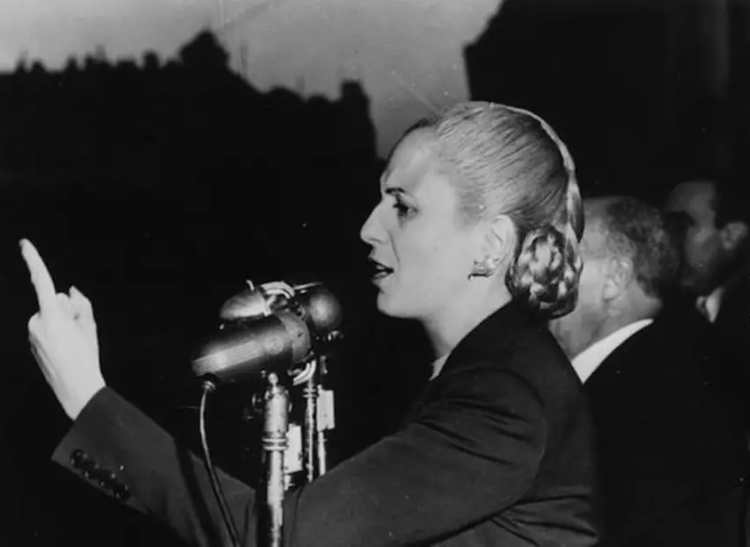
Rising in popularity, Perón decided to run for president. Eva campaigned tirelessly for her new husband, both on her radio shows and on the campaign. She often appeared with him at public engagements, unprecedented for an Argentinian woman. She appealed directly to the disenfranchised in Argentina, saying she knew their plight because: Soy uno de ustedes! (I am one of you). The public began referring to her lovingly as simply “Evita!”
Juan Perón won the presidential election with a 52% majority.
Evita proved to be a powerful influence as First Lady, fighting for women’s suffrage and to improve the lives of the poor. She kept her promise to the working class. In everything but title, she effectively ran the Ministry of Labor, supporting higher wages and social welfare benefits. Evita kept a high public profile, visiting factories and hospitals, and holding dozens of union meetings. She even toured Europe to raise support for her husband’s administration internationally.
But she was not without critics and detractors. Evita angered the wealthy elite with her campaign for the female vote. Suffrage for women was finally enacted in Argentina, largely due to the energy that Evita poured into the campaign.
Like every woman of the people, I have more strength than I appear to have.
Eva Peron
Not long after the election, the National Congress passed Argentine Law #13,010 in 1947, finally granting women the right to vote. But it did not pass without a hard fight by Eva. All around the nation, women thanked Evita for their right to vote. And she wasted no time in founding the Female Peronist Party. Argentine women registered and voted in droves.
Since the 18oo’s, charitable works in Buenos Aires had been carried out by the Society of Beneficence, a group of wealthy, older ladies. Traditionally, the First Lady was the head of the Society, but in 1946, they snubbed young Evita. She was livid! Evita basically crushed the society by removing their government funding, then starting her own foundation:
The Eva Perón Foundation
In 1948, she established the Eva Perón Foundation – with its first 10,000 pesos coming from her own money. The Foundation provided unprecedented relief for Argentina’s poor, giving away thousands of shoes and sewing machines annually. It provided pensions for the elderly, homes for the poor, schools and libraries in Buenos Aires. The unions and wealthy, looking for political favor, lined up to donate.
Eva personally oversaw it, working tirelessly to raise money, meet with the poor AND listen to their stories. Having once been in poverty herself, Evita understood their lives. Even as her health began to deteriorate, Evita continued to work daily at the Foundation, ignoring the pleas of her doctors and husband to rest. That year, she’d been diagnosed with advanced cervical cancer. She initially kept the diagnosis a secret from her husband.
Juan Perón was coming up for re-election in 1952.
In 1951, he had to select a running mate and he wanted it to be Evita. The working class was overwhelmingly in favor of Evita as VP. Even Juan was surprised at the popularity of his wife, showing him just how important she had become to his own political future. The military and upper classes however were would not accept an ‘illegitimate actress‘ running the country if her husband died.

At a summer rally in 1951, hundreds of thousands chanted her name. “EVITA! EVITA! EVITA!” She bowed out, however, telling her adoring masses that her only ambitions wereto serve the poor and her husband. In reality, her decision was probably due to a combination of military pressure and her own failing health. Evita’s new female voting bloc re-elected Juan Perón with a landslide 63% of the vote.
Aggressive treatment of her cervical cancer, including a hysterectomy in New York City, could not halt its advance. In May 1952, on Evita’s 33rd birthday, Juan Peron gave her the title, Líder Espiritual de la Nación (Spiritual Leader of the Nation). Evita made her last public appearance in June 1952, at her husband’s second inauguration. She was so weak, she was unable to stand without support. Everyone knew the end was near – Evita did not deny it.
A month after the reelection, she died in July 1952 at the age of 33.
The public’s grief was overwhelming and unprecedented. Argentina went into mourning unlike any seen since the days of Spanish kings. People piled flowers high on the streets, Argentinians crowded around the presidential palace. The nation gave her a funeral fit for a head of state. A devastated Perón planned an elaborate monument, but it was never completed before he lost power. Evita is buried in the Recoleta Cemetery in Buenos Aires.
Without Evita, another coup removed Juan Perón from power in 3 years, fleeing to Spain. Her final legacy is still hotly debated as both her supporters and enemies wrote her legacy. Peronism is still a powerful political movement in Argentina. Evita is considered a saint by the poor that adored her. She‘s appeared on stamps and coins. There are hundreds of schools and hospitals named after her. Every year, thousands visit her tomb in Recoleta. Her husband Juan died of a heart attack in 1974 at 78.
Evita Peron has been immortalized in countless books, movies, poems, and paintings. Perhaps the most well-known is the 1978 Tony Award winning musical Evita, written by Andrew Lloyd Webber and Tim Rice. It later inspired a 1996 movie starring the singer Madonna as Evita and Jonathan Pryce as Juan. Her leadership and dedication to the poor has served as an inspiration for millions of women around the globe. Her legend only continues to grow.