An Immigrant’s Ellis Island Fate Depended on 29 Questions

Ellis Island Immigration Station, New York Harbor, 1900

CLICK HERE FOR AN AUDIO PODCAST

For a vast number of Americans, including myself, our great-grandparents arrived in the U.S. as immigrants in the early 1900’s. There were no modern airports back then, just a vast, grey ocean to cross.  So all the Poles, Russians, Italians, Greeks, Swedes, Hungarians, Germans and dozens of other nationalities made “The Crossing” and arrived by coal-fired steamship. 

For passengers newly arrived in New York City, 1st & 2nd class were left off in lower Manhattan with a just precursory check of their papers.  Poorer immigrants in Third Class or “Steerage,” however were ferried by barge, along with their meager baggage to Ellis Island, sitting in the shadow of Lady Liberty.  There, with a ship’s manifest number pinned to their clothes, they queued up by the thousands to enter the intimidating Immigration Station with its 4 ornate, domed towers.

After dropping off their luggage in the Baggage Hall, nervous immigrants were marched up a winding flight of stairs to the GREAT HALL, with its impressive, high arched ceiling and arched windows.  In the Registry Room, they wandered through a maze of tall metal pipe railings for registration.  One can only imagine the myriad of languages and smells that filled that historic chamber.   

First, each immigrant underwent a very brief physical exam (which included an assessment of their mental state).  In particular, doctors looked for rashes, fever, birth defects, limps, labored breathing, excessive coughing, lice, trachoma – a contagious eye disease, and even “feeble mindedness.” If they saw nothing suspicious, it lasted all of three minutes.  Anyone with suspected health issues was marked with white chalk on their clothing and sent to the Ellis Island Hospital, where their ultimate fate would be determined later.

The physicians’ letter code was X for a mental illness, B for back, G for goiter, E for eyes, L for lameness or limp, F for feet, H for heart, Pg for pregnant, P (pulmonary) for lungs, Sc for scalp, or S for senile.

If they passed the physical, the next step was waiting in long lines once again for questioning by the Immigration Inspectors.  Sitting on tall stools behind high desks, with translators at the ready, they had all the ships’ manifests in front of them.  An immigrant’s fate in the U.S. literally depended on these single men.  Any issue might put an immigrant in front of the dreaded Board of Special Inquiry, who would ultimately decide if they could stay in the U.S. or not.

During their crossing, they were required to complete 29 QUESTIONS and hand them in at Ellis Island.

Parents would complete the questions for their children.  Their answers became part of the ship’s manifest and were later scrutinized by the Immigration Inspectors in Ellis Island’s Great Hall:
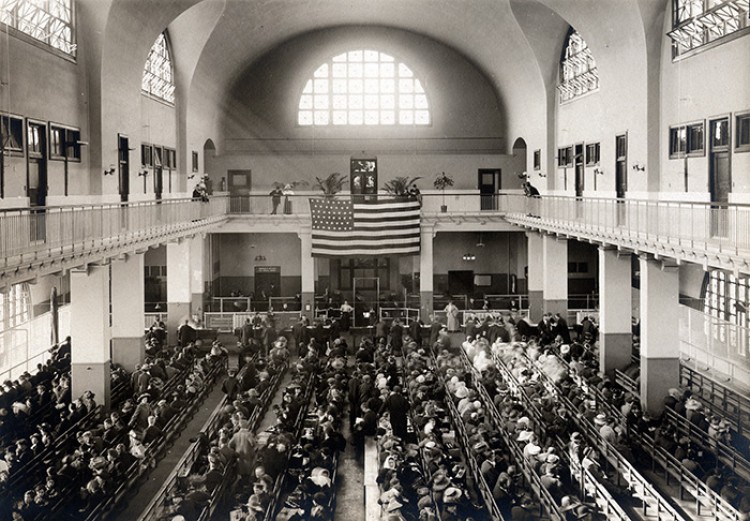
Ellis Island Immigration Station's Great Hall
Ellis Island Immigration Station’s Great Hall, 1910

  1. Your manifest number (from your ship)
  2. What is your full name?
  3. How old are you?
  4. Are you male or female?
  5. Are you married, single, widowed, or divorced?
  6. What is your occupation?
  7. Are you able to read and write? (yes or no)
  8. What country are you from?
  9. What is your race? (note: no question was asked about religion)
  10. What was your last permanent place of residence? (city and country)
  11. What is the name and US address of a relative from your native country?
  12. What is your final destination in America? (city and state)
  13. Your number on the immigration list?
  14. Do you have a ticket to your final destination? (yes or no)
  15. Who paid for your passage?
  16. How much money do you have? (at least the equivalent of $50 dollars was needed)
  17. Have you been to America before? If so when, where and how long?
  18. Are you meeting a relative here in America?  If so, who and their address?
  19. Have you been in a prison, charity almshouse, or insane asylum?
  20. Are you a polygamist?  (Yes or No)
  21. Are you an anarchist? (a real anarchist would have been a fool to say yes)
  22. Are you coming to America for a job?  What and where will you work?
  23. What is the condition of your health?
  24. Are you deformed or crippled?
  25. How tall are you?
  26. What is your skin color?
  27. What color are your eyes and hair? (much like on today’s driver’s license)
  28. Do you have any identifying marks? (scars, birthmarks, or tattoos)
  29. Where were you born? (city and country)

[More at: https://www.nps.gov/elis/learn/historyculture/index.htm]

The key questions the inspectors focused on were purposely scattered throughout the list – in particular, numbers 6, 16 and 22.  Basically Do you know a trade?  Do you have enough money? And Where will you work in the United States?  In other words, would you be able to contribute to the United States, or be a burden on its society?

Due to the thousands being processed daily, the interview could take as little as three minutes!

If all was in order, physical and questionnaire, the nervous and very relieved immigrants were released. And that was it! There were NO complicated asylum requests, immigration judges, Green Cards or Visas to deal with back then. The entire process, including waiting in line, could take up to 5 nerve-wracking hours.  At any time, our ancestors might be denied entry and sent back across the ocean on the next available steamship.

The Immigration Ledger recorded: Family Name – Given Name – Age – Sex – Marital status – Read (Y/N) – Write (Y/N) – Nationality – Race – Occupation – Height – Hair Color – Last Residence – Final Destination.

Leaving the Great Hall were the Stairs of Separation where those free to go went down one side, and those detained went down another.  Dormitories were on the island to house the detainees.  That’s why it was referred to both as The Island of Hope and The Island of Tears. Once cleared however, they could go downstairs and grab a cheap meal in the Dining Hall, retrieve their meager baggage, exchange their foreign currency for dollars, and then be ferried to train stations in New Jersey or New York for trips westward.

Immigrants lined up to leave Ellis Island
Immigrants lined up with their baggage to leave Ellis Island, 1910

Imagine leaving all that you knew – your former life, and often some family, completely behind – with the hopes of a better life in free America, the land of unlimited opportunity.  Perhaps you were fleeing World War I or tyranny or poverty. You likely spoke not a word of English!  A single carpet bag or leather satchel carried all your worldly possessions – a change of clothes, all the money you had in the world, a treasured picture or two.  You survived a wave-tossed Atlantic crossing in the belly of a cold steamship, in overcrowded 3rd Class conditions with poor food and sea-sick passengers. Now your fate was determined by a physical exam, three minutes with an inspector, and 29 Questions!

While approximately one in five were detained for the hospital or Board of Special Inquiry, only 2% of the 12 million immigrants processed at Ellis Island from 1892 to 1954 were ever deported and sent back to their countries – ONLY TWO PERCENT.  The rest were welcomed into the ‘Melting Pot’ that is the United States of America.  They became our grandparents and great-grandparents. 

They were NOT, however, generally welcomed by the average, established American. This included, ironically, the Irish Americans who had come to the U.S. decades earlier.  Bigotry and discrimination against immigrants were unfortunately the norm for decades, leaking unfortunately into our modern times.

Nevertheless, a century of their hard working class labor in mills and factories helped make America into the great and powerful nation it is today. Most eventually became American citizens.  Their foods, their holidays, their customs and traditions all joined the Melting Pot and became American standards over the generations.  Try to imagine the U.S. without Italian pizza, German Christmas trees, Mexican tacos, or Irish St. Patricks Day.   Most Americans wouldn’t be here, if it wasn’t for the courage and sacrifice of their immigrant ancestors and the nation that welcomed them.

Some thoughts to ponder as, a century later, immigrants and immigration are yet again at the forefront of the American way of life, and indeed across the entire world.

Click BOOKS for more by historical writer Paul Andrews.
主页 » 博客 » Page 25

The Lindbergh Kidnapping – a Real Crime of the Century

Lindbergh Kidnapping Headlines
Lindbergh Kidnapping Headlines, 1932

Aviator Charles Lindbergh famously flew his single engine plane, The Spirit of St. Louis, for 33 hours from Long Island to Paris in 1927. He became the first to cross the Atlantic Ocean solo. The blond, handsome airmail pilot, only 25 years old, became an international superstar. He was like a movie-star crossed with a sports-star. The kidnapping and murder of his toddler son was to end all that.

Five years after his famous flight, ‘Lucky Lindy’ would be at the center of The Crime of the Century. On Tuesday, March 1st, 1932, two year old Charles Lindbergh Jr. was suffering from a winter cold.  Charles Sr., his wife Anne and son were at home on their new estate in Hopewell, NJ. Little Charlie’s nurse, Betty Gow, put him to bed around 7:30 pm.  His parents sat in the parlor, reading and listening to the radio. At 10 pm, the nurse returned to check on him and made a horrifying discovery – Charlie Jr. was gone and the bedroom empty!  Lindbergh rushed upstairs, flung opened the nursery door, and found the bed empty. He noticed an open window with an envelope lying on the sill. 

The envelope contained a badly written ransom note that said:

“Dear Sir, Have $50,000 ready … After 2-4 days will inform you were to deliver the mony. We warn you for making anyding public or for notify the Police, the child is in gut care.”

Excerpt of Lindbergh Kidnapping Ransom Note, 1932

A kidnapper had used a homemade ladder to climb to the 2nd floor and left muddy footprints in the room. Lindbergh dashed downstairs, grabbed his hunting rifle, and with their butler, went out searching the woods. Charles Lindbergh ignored a warning in the note and called the local and state police. A massive search of the surrounding woods ensued. By 10:30 pm, the radio was announcing the shocking news to the world. They next day, every U.S. newspaper gave the story its headlines. Soon, false sightings of the Lindbergh baby were coming from all corners of the country.  None were real.

Second story bedroom window used in the Lindbergh kidnapping, 1932

Colonel Norman Schwarzkopf of the NJ State Police was in charge of the case, but ceded responsibility for the investigation to the famous Lindbergh himself. Headquarters for the investigation were established in the family’s home. Lindbergh’s inexperience however produced some major goofs – footprints near the house were trampled by the searchers and evidence was mishandled by too many people. No fingerprints were found. The state police offered a $25,000 reward for anyone who could provide information pertaining to the case.

Then, a follow-up letter showed up on March 6th, with more instructions, this time demanding $70,000 as penalty for going public.

Other blunders and oddities in the case would follow …

Even gangster Al Capone offered his assistance – in return for being released from prison. The authorities did not take him up on it. A week later, John Condon, a retired teacher from the Bronx, called the Lindberghs, claiming he had made contact with the kidnappers! Condon had written a letter, published in the Bronx News, offering to act as independent intermediary. A man named John, claiming to be the kidnapper, wrote to him. Condon was allowed by a desperate Lindbergh and the police to make contact with the kidnappers.

On April 2nd, the ransom money, in gold certificate bills, was delivered by Condon to a Bronx cemetery, while Lindbergh himself waited with police in a nearby car. The kidnapper said they were a gang of Scandinavians and gave Condon a note, supposedly revealing the baby’s safe location.  It led them to the New Jersey coast in search of a boat called Nelly. No boat nor the Lindbergh baby were ever found. They’d been double-crossed.

On May 12th, 72 days after the kidnapping, a truck driver named Orville Wilson stopped on the side of the road in New Jersey to relieve himself. He found the decomposed body of a baby boy in the woods, less than 5 miles from the Lindbergh house. The child had been dead from a fractured skull, presumably dropped from the ladder the night of the kidnapping. He had been dead all along. The kidnapping case was now a murder investigation.

Serial numbers from the ransom money first surfaced in New York City. Over the next two years, more and more of the dollars would pop up. Finally, in September 1934, a marked bill turned up at a gas station in Manhattan’s east side. The attendant wrote down the license plate of the customer, who gave him a $10 bill for 98 cents of gas. It was tracked to a German immigrant carpenter by the name of Bruno Hauptmann. When his Bronx home was searched, detectives found $14,000 of the Lindbergh ransom stuffed in an oil can. Despite his pleas of innocence, Hauptmann was arrested and indicted for murder, 2 years after the crime.

The Crime of the Century became the Trial of the Century.

60,000 people besieged the tiny town of Flemington, NJ.  Hauptmann was defended by “Big Ed” Reilly, a flamboyant attorney who had seen better days. Lindbergh himself testified that he recognized Hauptmann’s voice from the night he & Condon delivered the ransom money in the graveyard. Hauptmann took the stand and strongly denied any involvement. He claimed a friend, who had died in March, and had distrusted banks, had given him the money to hold. He said he had been beaten by the police while in custody and forced to alter his handwriting to match the ransom note.

The prosecution’s case was not airtight. Besides the money, the main evidence was testimony from handwriting experts and the prosecution’s claim of a connection between Hauptmann, a carpenter, and the wood used in the home-made kidnapping ladder. Following 11 hours deliberation, the jury found Hauptmann guilty of first degree murder..

The evidence and public demand for blood were enough to convict.  Hauptmann was sentenced to death. Appeals were made all the way to the Supreme Court, but none were successful. NJ Governor Harold Hoffman voiced doubts about the case and the verdict, and even visited Hauptmann in his cell. Questions were raised – ranging from witness tampering, to evidence planting, to who his co-conspirators might be?  Nevertheless, Hauptman was executed at Trenton State Prison on April 3, 1936 in the electric chair. 

Conspiracy theories abound to this day, claiming poor Hauptmann was framed and the kidnapping was in fact ‘an inside job’ within the household staff. One theory even claimed that Lindbergh himself accidentally dropped the boy from the window and orchestrated the entire kidnapping cover-up.

Charles and wife Anne Lindbergh
Charles and wife Anne Lindbergh during the investigation, 1932.

In the aftermath of the infamous crime, kidnapping was made a federal offense via the ‘Lindbergh Law‘ in 1932.  To escape the intense publicity, Charles Lindbergh and his wife moved away from Hopewell in 1936, living in England. They returned to the U.S. in 1939 prior to World War II to live in Connecticut.  During the war, he was suspected by President Franklin Roosevelt and the White House of being a Nazi sympathizer due to his staunch anti-war speeches and anti-Semitic beliefs.

He and his wife Anne went on to have 5 more children.  After the war, he also secretly fathered 7 illegitimate children with 3 different German mistresses. They never knew the famous Charles Lindbergh was their father until after his death when love letters were discovered. Lindbergh died from lymphatic cancer in Hawaii in 1974 at age 72. Anne Lindbergh lived a long life and passed away in 2001 at age 94 of a stroke. DNA tests conducted in 2003 have since confirmed the lineage of Charles’ seven illegitimate German children.

如需阅读历史作家保罗·安德鲁斯的更多作品,请点击书籍。
主页 » 博客 » Page 25

The Race for the Polio Vaccine – Salk vs. Sabin

Dr. Jonas Salk on the cover of Time magazine 1955

Long before COVID, during the early 1900’s, summer was not a welcomed season for both parents and children.  For back then, summer was also ‘Polio Season.’ Children were susceptible to poliomyelitis, an incurable disease that affects the central nervous system resulting in paralysis.  Polio is a highly contagious virus that spreads from contact with water or food tainted with fecal contamination. ‘Polio Panic’ was a surpassed only by fear of a nuclear World War III. The world desperately need a polio vaccine.

That the disease crippled so many children was alarming enough. But the shock wave that followed a local outbreak was devastating. Communities resorted to measures used to combat the spread of influenza or even small pox. Neighborhoods were quarantined, schools and movie theaters closed, windows were shut in the summer heat, and public pools abandoned.

Worse still, most hospitals refused to admit children with polio. Families were forced to rely on house calls by doctors who could do little more than fit tiny children with heavy metal braces. Polio paralyzed some patients’ chest muscles removing their ability to breathe. If they were fortunate, they would be placed in one of the dreaded IRON LUNGS, huge cylindrical respirators which pulled air in and out of their small chests.

In 1921, the war on polio recruited an unlikely ally.

Although polio mainly struck children, 39-year-old Franklin Roosevelt became ill after attending a summer Boy Scout rally. Within days, he was paralyzed from the waist down. Although as President he hid his disability from the public, he became a champion of its medical research. In 1937, he announced the formation of the National Foundation for Infantile Paralysis, also known as The March of Dimes. Citizens donated dimes to support polio research. In the first year alone, it raised almost 2 million.

Two heroes emerged in the 1950s, waging war against polio. The 1st, Dr. Jonas Salk of the Univ. of Pittsburgh developed a method to kill the virus with formalin. When injected into monkeys, his vaccine protected the animals against polio! In 1952, Salk began testing in humans, starting with children already infected with the virus, often at institutions for the disabled or mentally ill. Strongly believing in his vaccine, Salk went so far as to inject himself, his wife, Donna, and their three sons in the family’s kitchen.

Controversy arose when a 2nd competing researcher, Dr. Albert Sabin of the Univ. of Cincinnati, claimed Salk’s inactivation method failed to kill ALL the polio virus. Sabin was almost a decade older and considered the more experienced researcher. Testifying before Congress, he attacked Dr. Salk’s killed-virus vaccine. There was no proof the vaccine conferred long-lasting immunity.

Sabin predicted that any live virus remaining in the vaccine would doom innocent children.

Despite these doubts, Salk’s method was validated and he published his results in 1953. The March of Dimes decided to finance a massive Field Trial of Salk’s vaccine on 2 million American children between 6 and 9. The large-scale trial was made possible by major pharmaceutical companies like Eli Lilly, Wyeth Labs, and Parke Davis, producing his vaccine on a large scale.

In 1954, half of these “Polio Pioneer” children received a vaccine injection, while the other half received a placebo. Significant risks exist when administering any untried vaccine. As Salk told a journalist:

“When you inoculate children with a polio vaccine for the first time, you don’t sleep well for two weeks.”

Dr. Jonas Salk

On April 12, 1955, on the 10th anniversary of FDR’s death, Dr. Thomas Francis, Salk’s mentor and the trial director, called a press conference at the University of Michigan to report the results. Salk was still in the dark as to the conclusion, and had little idea what Francis would say. The conference was broadcast to 54,000 physicians; millions of Americans tuned in by radio. The pronouncement was stunning.

The vaccine was safe, potent, and 90% effective in protecting against polio!

The audience of over a thousand gave Salk a standing ovation as he took the stage. A pleased, yet overwhelmed Salk looked at the crowd. “The objective here was not merely a reduction in crippling cases of polio, but rather the elimination of fear.” He thanked the many people who had made this success possible, but failed to mention his closest colleagues by name. This caused a rift between Salk and some of his research associates that persisted for decades.

There were over a hundred reporters at the event. Word got out around the globe overnight. The polio scourge had been whipped! Every front page and newscast proclaimed the victory. Polio panic would soon be over as pharmaceutical companies would create millions of doses of the new vaccine. Church bells and fire sirens sounded across the US. People gathered in churches to pray thanks. Many openly wept.

Salk immediately became a national hero and celebrity. That evening, he appeared on Edward R. Murrow’s television show See It Now. “Young man, a great tragedy has befallen you,” Murrow said, “you have lost your anonymity.” When asked who held the patent on the vaccine, Salk’s response became legendary:

“Well, the people, I would say. There is no patent. Could you patent the sun?”

Dr. Jonas Salk, when asked who owned the patent

Salk disagreed with owning a patent as millions of Americans had paid for the research via the March of Dimes.  Of course the polio vaccine wasn’t novel enough to be patentable according to US law, and Salk knew it.  Forbes once estimated that Salk could have earned over $7 billion in revenues.

President Eisenhower gave Jonas Salk a special citation at the White House.

The fame was unwanted however. Hotels offered Salk their best suites, pilots announced his presence on airplanes, he could not eat at restaurants as everyone wanted to shake his hand. The March of Dimes lionized Salk to the point of offending his colleagues yet again. Other researchers grumbled that he hadn’t found anything new; just applied research that was already there.

Around the same time that Salk began his work, Dr. Albert Sabin began working on a weakened live-virus vaccine. Sabin felt that his oral vaccine was superior to an injection, as it would be easier to give to kids and cheaper to manufacture. Sabin began testing his vaccine on humans, included prisoners from Ohio’s Chillicothe Penitentiary. Volunteer inmates were paid $25 with a promise of some time off their sentences. None of the 30 prisoners developed polio, and the test trial was deemed successful.

Just 2 weeks after the victory announcement, scattered reports appeared of children developing polio after vaccination. An investigation implicated one of the manufacturers, Cutter Laboratories. Cutter was quick to blame Salk’s inactivation method, arguing it didn’t work on large batches. Albert Sabin chimed in calling it the “Salk Accident.” Jonas Salk was in the spotlight again, but for the wrong reason.

It was soon discovered that Cutter failed to follow Salk’s strict protocol for inactivating the virus.

The ‘Cutter Incident’ was heartbreaking for Salk. “I cannot escape a terrible feeling of identifying with these poor people who got polio.” Because of Cutter’s cost-cutting, 260 people contracted the disease. Nevertheless, his vaccine proved a Godsend. By 1961 polio, was all but eradicated from the United States.

Because Salk’s vaccine was now being used in the US, Albert Sabin couldn’t get support for his large-scale field trial like that of Salk. In 1957, Sabin convinced the Soviet Union to conduct field studies on his oral vaccine. Ultimately 2 million Soviet children were vaccinated. Sabin’s Russian trials were also deemed highly successful.

Dr. Albert Sabin and his polio vaccine, 1963

Sabin quickly entered into an agreement with Pfizer pharmaceuticals to produce his ‘attenuated‘ live-virus vaccine. Sabin’s oral polio vaccine, administered to kids on a sugar cube, eventually replaced Salk’s injected vaccine in many parts of the world. By 1963, it became the gold standard, and the one used to eradicate polio globally.

Salk claimed his killed virus vaccine was safer, but his resistance was futile. The Sabin polio vaccine, cheaper and easier to deliver, won the race in the end.  Sabin belittled Salk’s earlier achievement as “kitchen chemist’s work,” which anyone could have done. Subsequent honors went to Albert Sabin that never came to Salk, like membership in the prestigious National Academy of Sciences. Neither Salk nor Sabin ever received the Nobel Prize in medicine. It’s been speculated this was due to their close, but necessary, ties to the pharmaceutical industry.

In 1963, The Salk Institute opened in La Jolla, California. He got funding from the March of Dimes and recruited Nobel Prize-winning scientists to investigate cancer, diabetes, multiple sclerosis, and eventually AIDS. So although Jonas Salk is credited with ending the scourge of polio because his killed-virus vaccine was first, Albert Sabin’s inexpensive sugar cube vaccine continues to successfully prevent the spread of polio in every corner of the world to this day.

Dozens of new safe and effective vaccines, in the decades since polio have revolutionized global immunization, most especially for childhood diseases. As the world currently rushes towards vaccinations for new viral variants, take note of the years of careful scientific research it took to get a successful and safe polio vaccine for millions around the world.

如需阅读历史作家保罗·安德鲁斯的更多作品,请点击书籍。
主页 » 博客 » Page 25

The Woman on the Dollar Coin – Susan B. Anthony

susan-b-anthony
Susan B. Anthony, Abolitionist and Suffragette, 1872

What does the average American know about Susan B. Anthony other than: She’s that stern-looking woman on a U.S. dollar coin. Susan B. Anthony lived a very long and very productive life over a century ago as a leading Abolitionist and Suffragette. In fact, women would not have had the right to vote as early as they did (1920) if it were not for the tireless work of Susan B. Anthony.

Born in 1820, she grew up in Rochester, NY, the child of Abolitionist Quakers. At 17, she went off to a boarding school to become a teacher, and at 26 was made Head Mistress of a Women’s Academy, an impressive feat for someone so young.  By 29 she was involved in the early Temperance (Prohibition) movement, giving speeches on women’s rights.  What did Temperance have to do with women’s rights, you might ask?

If a woman divorced her alcoholic husband, she forfeited everything – her home, money AND children to her spouse.

In 1852, she met a woman who would change her life forever, Elizabeth Stanton, one of the original US suffragettes. Stanton was already famous herself for organizing the Seneca Falls Women’s Rights Convention 4 years earlier. Together the duo made an efficient team as Elizabeth was a talented writer and Susan a dynamic speaker. They formed the National Woman’s Suffrage Association, which by the way, is still around today. You might know it as the League of Women Voters.

During the Civil War, she helped none other than Harriet Tubman ferry escaped slaves through New York state to Canada on the famous Underground Railroad. She assisted Abraham Lincoln by canvasing the northern states, collecting over 400,000 signatures on a petition to pass the 13th Amendment, abolishing slavery. The Amendment was narrowly passed by Congress in 1865.

After the Civil War, in 1868, she and Stanton started The Revolution, not A revolution, but rather a NY newspaper with that purposely provocative title.  It was the first newspaper published by women, written by women, for women readers.  Sadly, The Revolution only lasted 2 years due to a lack of funding from any male backers or advertisers, but it was still revolutionary, and made Susan B. Anthony famous as well.

In 1872, the 14th Amendment passed giving Blacks the right to vote.

It was written stating all US citizens had the right, so Susan and 50 of her followers convinced pollsters in New York state to allow them to vote in the presidential election that year since women were citizens too. Vote they did and were promptly arrested by a Marshal.  As the instigator, Susan B. was the only one put on trial in The United States vs. Susan B. Anthony.  An all male jury found her found guilty of illegally voting. She was not allowed to speak until after her sentencing.

When the judge finally asked her if she had anything to say, she stood and let fly a now famous invective stating:

My constitutional, civil, and judicial rights were tramped upon as I did not have a jury of my peers, for they were all men!  The laws were made by men, under a government of men, and for the benefit of men! The only chance women had for justice was to violate the law, as I have done, and vow to continue to do!

Susan B. Anthony at her 1873 trial

The flustered Judge Ward Hunt fined her $100, which, she refused paid. The judge wanted her out of his sight and did not order her to be taken in further custody.

She did not stop there. In 1893, Susan B. learned the Chicago World’s Columbian Exposition would have no exhibit noting the contributions of women. She lobbied the wives of Washington cabinet members, senators AND Supreme Court justices. She eventually got a Women’s Pavilion, designed by a female architect, added to the Worlds Fair, at which women’s accomplishments and rights were proudly displayed and freely discussed. Susan B. spoke to large crowds at the exhibition about woman’s rights.

Sadly, Susan B Anthony never saw women get the right to vote.

Susan B. Anthony in her later years
Susan B. Anthony in her later years, 1893

She semi-retired at 71 to Rochester, NY though still remained an active suffragette. Her 80th birthday was celebrated at the White House with President William McKinley. She died of pneumonia in 1906 at the age of 86. In case you were wondering, she never married, deciding early on that having a husband and children could impede her tireless work for women.  

Susan B. Anthony inspired and left thousands of women’s rights advocates in her wake. Her last words were ‘Failure is impossible.” And she was right.  Women did finally get the right to vote the same as men, 14 years later in 1920. The 19th Amendment to the U.S. Constitution is in fact officially known today as the Susan B. Anthony Amendment. The U.S. Post Office issued a stamp in her honor in 1931 and another in 1958. In 1979, a dollar coin was produced with a profile of her determined face, the first woman ever to be on U.S. currency.

Click BOOKS for more by historical writer Paul Andrews.
主页 » 博客 » Page 25

Australia began as a British Penal Colony over 230 years ago

Depiction of the British landing at Botany Bay, Australia
Depiction of the British landing at Port Jackson, Australia, 1787

It’s no longer a well-hidden fact, nor even an embarrassment, that Australia was founded as the Botany Bay Penal Colony in the late 18th century.  But how exactly did an entire continent come to be settled by British convicts?

Botany Bay is an inlet on the eastern coast of Australia, just south of Sidney.  In 1770, the bay was discovered by the famous British explorer Captain James Cook in his ship, the HMS Endeavour. It was named Botany Bay because of the abundance of plant life noticed by the ship’s naturalist, Sir Joseph Banks.

A decade later, recently deprived of its American colonies, Britain was desperate to find another territory to ship its criminals to.  At the time, criminals were considered defective, could not be rehabilitated and must be in fact be separated from its law-abiding citizens.  So prisoners had to either be executed or exiled! Cook’s Australia seemed to fit the bill as it was inhabited by only native Aborigines and no other European power had established a colony.  Based on Captain Cook’s report, Botany Bay was selected by parliament.

The first fleet of 11 ships, filled with 736 convicts, set sail from England in 1787.

They sailed for 8 long months, around Africa’s Cape Hope of Good Hope, into the Indian Ocean.  Captain Arthur Phillip, a tough but fair naval officer, was in charge of the fleet and with setting up the first penal colony in Australia. The 736 convicts were chained beneath the decks for the entire hellish voyage.  While the journey claimed the lives of just 39 prisoners, later trips would see up to a third die of disease and malnutrition along the way.

Interestingly, only a small minority were hardened criminals convicted of violent crimes.  Women made up 15% of the convict population.  Those ships carrying females inevitably became floating brothels.  The poor women were exposed to varying degrees of degradation with younger women lined up for inspection.  The prettiest were taken to the officers’ cabins, while the others were thrown in with the all male crew.

Discipline aboard ship was brutal, with the crew themselves often cruel drunks, recruited from dockside taverns. Most were thugs who didn’t shrink from doling out the most brutal punishment on any convict who broke a rule. Dysentery, scurvy and sea-sickness were also rife, making conditions below decks most foul indeed.

The fleet of ships finally sailed into Botany Bay in January of 1788.

Upon inspection though, the large bay was deemed uninhabitable due to a lack of fresh water and marshy soil.  Captain Philip’s surprise and disappointment must have been palpable.  This is where they sent him?  What was he to do now, with 6 ships full of 700+ convicts?  Based on Cook’s records, he took the fleet up the coast next, landing 9 miles away at Port Jackson in Sydney Cove, six days later.  Here all worries vanished as Phillip had just discovered one of the finest harbors in the world.

The night the first male convicts started landing, 26 January 1788, the Union Jack was hoisted, a succession of volleys fired from the ships, many toasts of rum were drunk, and Captain Philip led his officers in three cheers of “HUZZAH!”  Australia Day commemorates this first landing of white settlers on the continent.

For the convicts who disembarked in Sydney Cove, that 1st Australia Day, it was a bit bewildering. Unused to land after 8 months below deck, they stumbled through the cove’s alien forest.  It was 2 weeks before enough huts could be built for the female convicts to leave the ships.  In the midst of a storm, they held the first Australian Bush Party – dancing, singing and drinking into the night.

Though no longer confined behind bars, the convicts still had an extremely rough life ahead of them. The guards who signed up for duty in Australia were driven by cruelty bordering on sadism.  Governor Phillip was strict and even small violations could result in 50 lashes with a cat o’nine tails. Blood was usually drawn after the fifth, so the conditions of their backs after 50 was more like raw meat.

The female convicts were often reported as low-class, foul mouthed women with loose morals.

But women were often imprisoned in Britain as a punishment for simply misbehaving to a man, or having illegitimate children.  At Sydney Cove, they were forced to perform the more menial tasks like sewing clothes or toiling over wash-tubs. Punishments for women was not the whip, but rather having their head shaved as a mark of disgrace.

So who exactly were all these convicts forced to “the Land Down Under?”  They were prisoners yes, but only a small fraction were dangerous murderers.  Most were common poachers or thieves, while others were radical Luddites, Catholic Ribbonmen or Scottish Jacobites.  Regardless, all were treated the same by Phillip.

Those early days were perilous as their food stocks dwindled and rations were frequently cut. It was only the arrival of supply-ships that enabled the colony to avoid starvation those first years.  Two more fleets arrived in what was now called New South Wales in 1790 and 1791. Now called “transportees” rather than convicts, the average age was 26, and also included children.

Plus they now included emigrants and their wives, attracted to dreams of a better life than in England.  

And it was not just the poor who headed down under.  Australia became a place where Britain sent unacceptable members of all its classes, including the gentry. It was an ideal place to send a young man who had gambling debts, or who wasn’t particularly good academically, or who had gotten the family maid pregnant. The famous author Charles Dickens sent his two sons to Australia!

Whether they arrived as convicts or emigrants, the settlers faced a forbidding, unwelcoming landscape. In a continent with little water and poor soil, growing crops proved extremely difficult. The western interior, or Outback as it came to be called, offered no great river and many yeomen who ventured there perished in the brutal desert.

Nevertheless,  in the end most stayed and endured.  The emigrants went out beyond colonial control and squatted on huge tracts of land. While farming was hit or miss, the settlers soon realized the climate was perfect for sheep.  The animals, both the wool and meat, would become a mainstay of the Australian economy.

As settlements expanded, they came into conflict with the Aborigines, who had lived there for thousands of years.

Map of Botany Bay and Port Jackson, 1790
Map of Botany Bay and Port Jackson, New South Wales, 1790

Phillip ordered they must be well treated, and anyone killing Aborigines would be hanged.  The natives considered the continent theirs, so they began killing the settler’s livestock … or the settlers themselves.  This is when the guns came out and British firepower ultimately won.  Frontier wars, massacres and the introduction of European diseases, devastated the Aborigines, much like the Native Americans.

In 1851, gold was discovered in New South Wales, sparking a Gold Rush similar to California’s. Melbourne went from a small fishing village to one of the greatest cities of the empire in just 20 years.  Gold brought wealth to the continent and hastened an influx of even more migrants. The Gold Rush also sparked the beginning of the end for convict transportees, due to a growing resentment from the new population.

Over the next 80 years, from that first fleet, more than 160,000 convicts were transported to Australia from England, Ireland, Scotland and Wales.  After 1868, when convict transfers ended, Australians tried to hide their founder’s legacy, considering it a disgrace and embarrassment. 

But over the centuries, Australia’s shame has been transformed into national pride. The truth about who the “convicts” really were has helped remove the stigma.  Some were just kids, some did little more than steal a bag of flour, some were political prisoners. Today, about 20% of Australians are descended from those founding convicts, including many of its most prominent citizens.

如需阅读历史作家保罗·安德鲁斯的更多作品,请点击书籍。
主页 » 博客 » Page 25

Nikola Tesla and his Wardenclyffe Tower

Tesla's Wardenclyffe Tower on Long Island, NY
Tesla’s Wardenclyffe Tower on Long Island, NY, 1903

Eccentric inventor Nikola Tesla had worked with the likes of both Thomas Edison and George Westinghouse.  He was already famous for his invention of the AC (alternating current) electric motor.  Why stop there?  His futuristic Wardenclyffe Tower was intended to be the first ever wireless power transmission station.  Tesla envisioned transmitting messages across the Atlantic using the Earth itself to conduct the signals. To better compete with Giovanni Marconi’s new Radio, he added the claim of worldwide wireless power transmission via the earth’s ionosphere.

“Using the Earth itself as the medium for conducting the current, thus dispensing with wires … a machine, working like a pump, drawing electricity from the Earth and driving it back into the same, thus creating a ripple which, spreading through the Earth like a wire, could be tapped at great distances.” 

Nikola Tesla

The Croatian born Tesla had a tumultuous career after arriving in the US as an immigrant in 1884.  He quit working for Thomas Edison after just 6 months and failed in an attempt to start his own electrical company (Tesla Electric Light). He then licensed his famous AC induction motor patents to George Westinghouse, giving up his royalties as well. At the 1893 World Columbian Exposition in Chicago, he helped Westinghouse demonstrate AC electric lighting, besting Edison’s DC (direct current).

The brilliant, insomniac, workaholic’s mind never ceased to stop spinning with ideas.  Today, he would have likely been diagnosed with OCD (obsessive compulsive disorder). The Serbian-American inventor soon left Westinghouse and formed the Nikola Tesla Company in 1895.

He demonstrated his wireless power at Colorado Springs, sending lightning bolts 135 feet into the sky from his famous high voltage Tesla Coil.

With this highly publicized achievement under his belt, Tesla made the rounds to investors, wining and dining millionaires at Delmonico’s restaurant in New York City. The wealthy financier J. P. Morgan agreed to invest $150,000 to build a wireless station capable of sending messages across the Atlantic Ocean to London.

Nikola Tesla and the Tesla Coil
Nikola Tesla demonstrating his Tesla Coil, 1901

In 1901, Tesla informed Morgan of his intent to increase the power beyond Marconi’s feeble Radio but needed much more money.  Tesla also believed his new wireless electric current would make the sky glow like the aurora borealis, thus providing night time lighting as well! This was met with skepticism by the shrewd Morgan, who refused to fund a single dollar more without proof of transmission.  Despite this, Tesla purchased 200 acres on Long Island Sound in the Wardenclyffe resort community.

He started construction on a 187 feet tall octagonal tower with a mushroom shaped metal cupola 68 feet wide, weighing a staggering 55 tons, plus an iron core extending 120 feet into the earth.  Beneath it was the power station and boiler room. This soon sprouted curiosity. What was Tesla was up to at Wardenclyffe that he kept secret from the public and the press?  He would respond matter-of-factly to questioning reporters, stating only that, “We have been sending wireless messages and power from this station for long distances for some time.”  In truth, he was under tremendous pressure from Morgan to deliver.

Then for a single summer night in July 1903, newspapers excitedly reported the mysterious Tesla Tower had finally come alive!

Shooting off bright crackling flashes of blue lighting out into the starry night sky, the effect was visible for a hundred miles, as far away as Connecticut.  In 1903, it must have seemed like something from a Jules Verne novel come to life.  The next day, no explanation of the fantastic display was forthcoming from the enigmatic Nikola Tesla or his staff.  Sadly, Wardenclyffe Tower never operated at full power again.  Tesla gave no explanation as to why. When Tesla requested more money from J.P. Morgan, the investor replied curtly, “I have received your letter, and in reply would say that I should not feel disposed at present to make any further advances”.

Tesla’s finances began to unravel as investor money flowed instead to Westinghouse and Marconi’s successful radio. The press claimed Tesla’s tower was nothing but an elaborate hoax. In 1904, he took out a mortgage on Wardenclyffe, and four years later a second mortgage. In 1905, his patents on alternating current (AC) expired, halting his royalty payments. His mounting financial problems, stifled his neurotic inventor’s creativity, leading to a deep depression, and ultimately a nervous breakdown.

People living around the odd Wardenclyffe Tower noticed the Tesla plant seemed to have been abandoned.  In 1915, when his backers demanded to know when they were going to recapture their investments, the inventor was unable to give a straight answer.  With Tesla unable to make any further payments, the banks foreclosed on the Wardenclyffe property.  Sadly, his bank demolished the historic tower and sold it for scrap iron in 1917. For years they lease the land to a photo products company.

Despite his many inventions and patents, the eccentric Tesla lived a near recluse’s life.  Towards the end of his life, he lived alone in a New York City hotel room at the Hotel New Yorker, feeding white pigeons out his window.  A strict germaphobe, he preferred to dine alone and never married.  In 1931 he was featured on the cover of Time Magazine for his 75th birthday. He died almost penniless in 1943 at the age of 86.  George Westinghouse had been paying his hotel bills. The main building of the Wardenclyffe Tower remains standing to this day out on Long Island.

A century later, billionaire Elon Musk would choose the famous inventor’s name for his new electric car company, TESLA. Today, there are thousands of Tesla vehicles on the roads of our planet, a fitting legacy for the brilliant if erratic inventor of the AC electric motor. Musk later adopted Tesla’s risk-inclined flair with his successful SpaceX rocket program.  I leave you with this parting thought in Tesla’s own words:

“Perhaps it is better in this immature world of ours that a revolutionary idea instead of being helped and patted, be hampered and ill-treated by selfish interest, pedantry, stupidity and ignorance; that it be attacked and stifled; that it pass through bitter trials and tribulations, only to emerge all the more powerfully, all the more triumphantly from the struggle.”

Nikola Tesla

主页 » 博客 » Page 25

The American Legacy of the Cherokee Trail of Tears

TO L ISTEN TO THE AUDIO PODCAST?  点击此处

Depiction of the Cherokee Trail of Tears

“Old Hickory” General Andrew Jackson won the nasty, negative election of 1828 and was elected to the White House.  At this time, over 125,000 Native Americans still occupied millions of acres in North Carolina, Tennessee, Georgia, Alabama, and Florida – land they’d lived on for generations. After the Trail of Tears, there’d be few left anywhere east of the Mississippi.  Frontier Americans both feared and resented the many southeastern tribes. To them, Indians were an alien race who occupied land white settlers believed they deserved.  They desperately wanted to grow cotton and other crops in the fertile soil of the south.

George Washington had believed the solution to “The Indian Problem” was to civilize the savage and make them as American as possible. This included conversion to Christianity, learning English, and adopting the principles of property ownership. In the southeastern US, some Cherokee, Creek, Choctaw, Chickasaw, and Seminole tribes took up white customs and became known as “The Five Civilized Tribes.”  But their land was still valuable, ever more so as thousands of white settlers continued to flood the southeast. Many white settlers did not care how “civilized” the tribes were.  They wanted that land and would do anything to get it. They burned and looted villages and squatted on property that belonged to those tribes.

The new populist President Jackson was a staunch advocate for “Indian Removal.”

As a General, he’d led brutal campaigns against the Creeks & Seminoles that transferred thousands of acres from Indians to white farmers. As President, Andrew Jackson continued this crusade as his solution to The Indian Problem. In 1830, he signed the INDIAN REMOVAL ACT, giving government the authority to exchange Native land in the southeast for land west of the Mississippi in the Oklahoma territory.  The new law did required fair, voluntary and peaceful removal treaties and did not permit forced removal of tribes from their land. Nevertheless, Jackson ignored the wording of the law and proceeded to force Native tribes to vacate their ancestral lands.

The forced displacement of Native Americans had some eloquent opposition in Congress. Senators Daniel Webster and Henry Clay both spoke out frequently against the removal.  President Jackson ignored them.  In the winter of 1831, the Choctaws became the first tribe to be expelled from their land by the US Army. They made the journey to Oklahoma on foot, some bound, marching double file at gunpoint, without any food, shelter or other help from the military. Thousands died along the way. It was just the beginning of what one newspaper called the Trail of Tears and Death.  While Jackson put a very positive and populist spin on ‘Indian Removal’ in his speeches, the actual removal was anything but. There was little the native tribes could do to defend themselves.

The Cherokees however chose to take legal action. They were by no means frontier savages. They’d developed their own written language, printed newspapers and elected representatives to their government.   When the state governments threatened to seize their land, the Cherokees took their case to the Supreme Court AND WON! a favorable decision. In 1832, the opinion of Court was that states had no jurisdiction over the Cherokee Nation or claim to their lands.

However state officials simply ignored the Supreme Court’s decision, and President Jackson refused to enforce it. He was furious and personally insulted by the Court’s ruling shouting:

“The Supreme Court has made their decision, now let them enforce it!”

U.S. President Andrew Jackson

So the encroachment continued unabated.  Jackson proclaimed that if no one enforced the Court’s rulings (and he certainly did not), then the decisions was in essence stillborn.  Jackson himself defied the court’s decision  and ordered further removal of Native Americans. Under orders from President Jackson, the U.S. Army began strict enforcement of the Indian Removal Act. This defiant action set a precedent the government would use for decades to come when the forced removal of indigenous people from their ancestral land was deemed ‘necessary.’

In 1835, representatives of the Cherokee Nation negotiated a Treaty which traded all Cherokee land in Georgia east of the Mississippi for $5 million dollars and relocation assistance. While the treaty was a done deal, many Cherokee felt betrayed by their representatives and refused to leave.  The removal process continued nonetheless. In 1836, the government forced the Creek Nation from their land. Over 3,500 of 15,000 Creeks would not survive the long, harsh journey west.

By 1838, only 2,000 Cherokees had left.  The President was fed up with the delay and sent 7,000 troops to “expedite the removal process.”  The soldiers forced the remaining Cherokee refugees into stockades at bayonet point while white settlers looted their villages. About 20,000 Cherokees marched westward at gunpoint more than 1,200 miles. Diseases, dysentery, and starvation were rampant along the way.  More than 5,000 Cherokee, nearly a quarter, would die, with the remainder left to seek survival in a territory totally foreign to them.

By then, the deed was done.

White Cherokee Rose
White Cherokee Rose growing along the Trail of Tears

U.S. Troops had forced tens of thousands of Native Americans off their lands. The government promised their new territory would remain untouched forever, but of course history tells us how that went.  As white settlers hungry for homesteads pushed westward across the Mississippi, “Indian Country” would shrink yet again. The Oklahoma Land Rush was just one example to come.

According to legend, the white Cherokee rose, the state flower of Georgia, grew everywhere a Cherokee tear fell on the sad Trail of Tears. The flowers continue to grow wildly along many of the trails the Native American tribes took on their long journey westward to Oklahoma reservations.

如需阅读历史作家保罗·安德鲁斯的更多作品,请点击书籍。
主页 » 博客 » Page 25

APOLLO 1 – The Forgotten First NASA Disaster

Astronauts Roger Chaffee, Ed White, and Gus Grissom in Apollo 1, 1967

Everyone remembers the Challenger and Columbia Space Shuttle disasters. We all know the famous Apollo 11 Moon landing and the historic first steps of Neil Armstrong in 1969.  But few outside NASA recall the Apollo 1 Tragedy that happened just 2 years earlier.  On January 27, 1967, during a launch rehearsal at Cape Kennedy, a freak flash fire swept through the Apollo 1 command module with 3 astronauts sealed on board. The three men died inside, despite the best efforts of the launch crew to save them.  But how could this have happened on a simple practice run?

NASA had an intimidating goal before it, set by President Kennedy in 1961, “to land a man on the moon and return him safely to Earth” by the end of the decade. Earlier Mercury and Gemini flights were the first steps toward meeting that challenge. Apollo would take 3 astronauts all the way to the moon’s surface and back.

This first manned Apollo mission, designated AS-204, would be just an Earth-orbiting test flight.

The Commander was Virgil “Gus” Grissom, an Air Force veteran, mechanical engineer and one of NASA’s first Mercury Seven Astronauts. He was America’s 2nd person in space in 1961, riding aboard the Liberty Bell 7. Grissom then went on to successfully command Gemini 3, the first 2-man Gemini flight, before being selected by NASA for Apollo 1.

Another veteran astronaut, Ed White, was also chosen.  An Air Force Lt. Colonel test pilot, he was the 1st American to make a spacewalk, on Gemini 4 in 1965. The images of White floating above the curved blue Earth, linked by a skinny tether to the spacecraft are unforgettable, as are his words, “I’m coming back in, and it’s the saddest moment of my life.”

The third and last astronaut was Roger Chaffee a seasoned Navy lieutenant commander. Although a rookie in spaceflight, he had spent years supporting the Gemini program since 1963, including CapCom (Capsule Communications) on Gemini 4. He would now finally be getting his first chance to fly in space after five years of waiting.

Two weeks earlier, all 3 astronauts kissed their wives goodbye, hugged their kids, and left Houston for Cape Kennedy in Florida.  They would be taking part in a pre-launch test, within the Command Module mounted atop an unfueled Saturn 1B rocket on launch pad 34. Engineering changes were still in progress as NASA prepared for the test. The plan was to go through the entire countdown sequence.

On Friday, January 27th, the 3 astronauts climbed into their familiar silver space suits.

At 1 pm, they rode out to the launch tower and took the elevator to the top.  With the help of the launch crew, they climbed into their capsule.  The hatch was then sealed with a heavy ‘thud.’ A number of technical  problems cropped up immediately, which delayed the countdown for 4 hours.  Finally, a failure in communications forced a hold in the count at 5:40 p.m.  A frustrated Grissom shouted through the static, “How are we going to get to the Moon if we can’t talk between two buildings?”

By 6:31 pm, Launch Control was ready to pick up the countdown … when ground instruments showed an electrical surge in the AC voltage readings, possibly indicating a short-circuit in the capsule.  Four seconds later came frightening words from the Command Module over the speakers, almost casually from Chaffee: “I smell fire.”

Two seconds later, White reports louder, “We’ve got a fire in the cockpit.” The fire spreads throughout the small cabin in a matter of seconds. Chaffee shouts this time, “We have a bad fire!” followed by all three shouting as they struggled to get out. The last communication sadly ends 17 seconds after the start of the fire, followed by loss of all capsule telemetry.

The Apollo 1 hatch opened inward and was closed by several latches.  It was held tight by higher interior pressure and required venting before the hatch could be opened. It took a minute and a half to get the hatch open under ideal conditions.  Ed White, in the center seat, had to reach above and behind his shoulders to use a ratchet that would release the first of a series of latches. White made part of a turn with the ratchet before he was overcome by smoke.

Launch technicians ran towards the sealed command module as the capsule ruptured!

White flames and thick smoke billowed out, filling the enclosed entry room. Some feared the fire might set off the launch escape rocket attached atop Apollo’s nose. This might then ignite the launch tower. Many technicians ran, but others grabbed extinguishers and tried to rescue the astronauts. The intense heat and smoke kept forcing them back, but finally after 5 minutes, they opened the hatch. Firemen arrived within 3 minutes and doctors soon afterwards. Unfortunately, it was too late … the 3 astronauts had died.

The entire NASA community was in shock.  There had been NO fatalities during Mercury & Gemini. NASA impounded everything at the launch pad. A medical board eventually determined that the 3 astronauts died of asphyxia, with burns as a contributing factor. Fire had destroyed 70% of Grissom’s spacesuit, 20% of White’s and 15% of Chaffee’s. Doctors treated 27 men at the launch tower for smoke inhalation.

A NASA review board found a stray spark from damaged wires near Grissom’s seat started the fire. Fed by flammable materials such as nylon netting and foam pads, the blaze spread easily.  Because the cabin had been filled with 100% oxygen for many hours, the gas permeated all the material in the cabin.  The fire spread rapidly and the trapped astronauts had little chance of getting the hatch open.

Burnt interior of the Apollo 1 capsule
Burnt interior of the Apollo 1 capsule, 1967

The three men had perished probably within the first minute. Ed White, in the center seat, was found with his arms over his head as he struggled with the hatch.  And that hatch turned out to be too difficult to open in an emergency. The astronauts struggled in vain to crack the inward-opening door with the pressure inside the spacecraft higher.

The exhaustive investigation postponed any manned launch of the Saturn for nearly a year.

A number of changes were instigated in the Apollo program, including designing: a) a new hatch which opened outward and could be operated quickly in a matter of seconds, b) removing much of the flammable material and replacing it with self-extinguishing components, c) using a nitrogen-oxygen mixture instead of pure O2 at launch.

In the end, the resulting changes made the Apollo Command Module a highly reliable spacecraft.  With the exception of Apollo 13’s service module failure, it helped make the six Moon missions almost routine. The eventual success of the Apollo program is a tribute to Grissom, White, and Chaffee, whose tragic loss was not in vain.  Lessons learned from Apollo 1 stretch all the way to the Space Shuttle program, the International Space Station (ISS), and SpaceX.

The AS-204 mission was officially names “Apollo 1” in honor of the three astronauts.  NASA honors their sacrifice every January in an annual Day of Remembrance, which also includes the Challenger 1986 and Columbia 2003 Space Shuttle crews. An exhibit honoring the Apollo 1 crew opened at the Kennedy Space Center in 2017, with a special ceremony honoring the three astronauts on the 50th anniversary of the tragedy.

如需阅读历史作家保罗·安德鲁斯的更多作品,请点击书籍。

主页 » 博客 » Page 25

Podcast: Razor Tojo – Japan’s Adolf Hitler


Contrary to popular myth, Japan’s version of Adolf Hitler was not the Emperor Hirohito, but rather its infamous Minister of War, Hideki Razor Tojo. But who was this ruthless and powerful man so few outside Japan know of?  He rose to power in the 1930’s, began World War II in the Pacific, and was responsible for the deaths of millions of his own people and the Allies.

Japanese War Minister Hideki Razor Tojo
Prefer to read a Blog version instead?  点击此处

主页 » 博客 » Page 25

Podcast: Five Reasons the Johnstown Flood Disaster should never have happened

The terrible Johnstown Flood of 1889 was more of a man-made Tsunami.  Yes, there was flooding at first. The ‘Storm of the Century‘ rains arrived in the deep Pennsylvania valley on Memorial Day, 1889. The two rivers that flanked the steel mill town began to swell.  But it wasn’t until the aging South Fork Dam burst that the REAL tragedy occurred. The dam, owned by a wealthy country club, held back the waters of Lake Conemaugh, just14 miles upriver from the unsuspecting people of Johnstown.

Depiction of the Johnstown Flood and Stone Bridge Fire, 1889
Prefer to Read a Blog version?  Click Here

主页 » 博客 » Page 25