The Bubonic Plague Pandemic, AKA the Black Death

Depiction of the Black Death - Bubonic Plague
Depiction of the Middle Ages Black Death – Bubonic Plague

The Bubonic Plague, better known as the Black Death, was one of the worst catastrophes in recorded history.  From 1347 to 1351, it ravaged kingdoms across Europe, eradicating one- third of Europe’s inhabitants. It destroyed a higher proportion of the population than any other single known event since. At that time in the Middle Ages, no one was sure what caused the plague.  The living were barely able enough to bury the dead.  Over the next four years, the Black Death rampaged through Europe, killing more than 20 million.

The Bubonic Plague arrived in Europe in October 1347, when 12 trading ships from the Black Sea docked at the Sicilian port of Messina. Sicilians were horrified to discover most sailors onboard were dead, and those still alive were covered in putrid black boils that oozed blood and pus.  Sicily hastily ordered the fleet of “Death Ships” out of the harbor … but it was too late.

Europeans had heard disturbing rumors of a “Great Pestilence” spreading across the trade routes to the Far East. In the early 1340s, the disease had already struck China, India, and Persia.  It may have originated in the Qinghai Plateau of Central Asia.  After landing in Sicily, the Black Death creeped northwest into Italy, Spain, France and England.  The plague then spread northeast into the Germanic states, then on to Scandinavia and even Russia. It’s thought the Black Death spread at a rate of about eight miles a day, the rate an average horse-drawn wagon could travel in a single day.

Medieval physicians noted it took as little as 5 days to cause death. 

And these were 5 very bad days.  European doctors were ill equipped to deal with the Black Death. Swellings in the groin and armpits grew from the size of an egg to an apple, becoming infected plague-boils, called buboes.  The disease attacks the body’s lymphatic system, causing swelling in the lymph nodes clustered there.  Blood and pus rush out of the swollen boils when they burst, followed by a host of unpleasant symptoms—fever, vomiting, diarrhea, terrible pain—and in short order, death. The infection spreads quickly to the lungs causing pneumonia, and in some cases sepsis.

Medieval folk, both kings and peasants, believed the Black Death was a curse from God.  There was no known remedy, but people wanted something – anything.  Physicians relied on crude treatments like bloodletting and boil-lancing. Doctors wore long-beaked plague masks, filled with dried flower petals to mask the bad air surrounding the patients.  The superstitious looked to gypsy practices like burning herbs and bathing in rosewater.

Meanwhile, panicked, healthy people ran from the sick. Some doctors refused to see them; priests refused to administer last rites; and shopkeepers shut their doors. The only true remedy for the plague was to run away from it.  Many fled cities for the countryside.  Some, so desperate to save themselves, even abandoned their sick loved ones on their death beds.  But even in the countryside, they could not escape the Black Death, as it affected livestock as well.

The Bubonic Plague was a quick, indiscriminate contagion, merely touching the clothes of the sick appeared to pass the disease.  It was also terrifyingly efficient. People who were perfectly healthy one day could be dead the next.  The elderly and the children, male and female, royalty and peasants  – ALL were affectedNo one had immunity.  Many wealthy convents and monasteries lost more than half of their members, with some closing down. There were shortages of people to till the farms and tend cattle and sheep.

This pandemic was caused not by a virus, like COVID-19, but rather a bacteria, Yersinia pestis. 

The plague bacteria was identified in the 1890s, connecting it to animal fleas.   It was transmitted by, of all things, the bite of the fleas of rats. And there was no shortage of rats in the Middle Ages, especially on trading ships.  Its lethality arose from the onslaught of two phases: first bubonic, transmitted by rat fleas, and then pneumonic (transmitted airborne, person to person).  It’s worth noting that modern antibiotics can easily combat the plague.

50 million people may have died over the course of its 4 year run. It killed from 30-60% of the population in both rural and urban areas. Some communities were wiped out; others abandoned.  The term ‘quarantine’ originated in Venice, based on a 40-day Biblical period of isolation.  Sailors were kept on board their ships and not allowed to leave.  Cities that managed to keep the plague at bay were those that implemented strict quarantines, city gate & dock controls, health passports, and spy networks to signal when plague erupted in other cities.

Survivors decried the abandonment of the sick, and labelled clergymen and doctors who escaped the plague as cowards. They praised those who stayed on to nurse the afflicted, often losing their lives in so doing.  Looking for a scapegoat, some municipal governments, bishops, and kings accused Jews of spreading the Black Death by poisoning food and water.

They massacred entire communities of Jews for the supposed crime of causing the plague.

Because they didn’t understand the biology, many people believed the Black Death was divine punishment—retribution for sins against God such as greed, blasphemy, heresy, and even fornication.  By this logic, the only way to beat the plague was to win God’s forgiveness for their community.  How to do this? They purged their communities of ‘heretics’ and other troublemakers—like the aforementioned Jews.

The medieval mask of the Plague Doctor
The beaked mask of the Plague Doctor

Some wealthy men joined processions of Flagellants, traveling from town to town, engaging in public displays of penance and self-punishment. They would beat themselves bare chested with leather straps, studded with metal, while the townspeople watched. For a month, the flagellants repeated this ritual 3 times a day. They would then move on to the next town and begin the process all over again.

The plague never really ended and returned in smaller outbreaks decades later. There have actually been 3 Bubonic Plague Pandemics. The first was an international epidemic in the sixth century AD, the Plague of Justinian.  Second, starting with the Black Death, then breaking out every 20 or so years, until it disappeared after the Great Plague of London in 1665. Third, the disease broke out once more in Asia in the 1890s, where it’s still found in animals today.

One can surely expect that our current public health situation has improved to such an extent as to eradicate medieval bubonic plague, especially through our sanitary regulations and modern vaccines.  Right?  While antibiotics are available to treat the Black Death, according to the World Health Organization (WHO), there are still up to 1,000 cases of plague globally every year.  An outbreak in the city of Surat in western India in 1994 caused mass panic in the country.  700 were infected and 52 people died. With limited antibiotics available, 300,000 residents fled the city in just 2 days. Still, because of the rarity of the disease, no vaccine has ever been developed.

如需阅读历史作家保罗·安德鲁斯的更多作品,请点击书籍

主页 » 博客 » Page 20

IN FLANDERS FIELDS World War I Poem Written over 100 Years Ago

Over 100 Years ago during World War I, the famous & haunting poem IN FLANDERS FIELDS was written. It was penned by 41 year old Canadian Physician & Lieutenant Colonel John McCrae in May 1915.  He was moved to compose the poem after the hellish Second Battle of Ypres in Belgium.  It was in Ypres that poison mustard gas was first used by the German military against the Allies – in the trenches surrounding No Man’s Land on the Western Front. He presided over the burial service of a close friend and fellow soldier, Alexis Helmer.  McCrae noticed that red poppy flowers quickly grew on the thousands of fresh graves in Flanders’ fields.  He took out his pen and pad, then wrote this brief yet moving poem:

In Flanders Fields
World War I soldier pays his respect to a fallen comrade In Flanders Field
 In Flanders fields the poppies blow
Between the crosses, row on row,
That mark our place; and in the sky
The larks, still bravely singing, fly
Scarce heard amid the guns below.
*  *  *
We are the Dead. Short days ago
We lived, felt dawn, saw sunset glow,
Loved and were loved, and now we lie
In Flanders fields.
*  *  *
Take up our quarrel with the foe:
To you from failing hands we throw
The torch; be yours to hold it high.
If ye break faith with us who die
We shall not sleep, though poppies grow
In Flanders fields.

His poem was published later that year in 1915 and became one of the most popular and quoted poems of the 20th century.  Over 115,000 Canadian, British, French and German soldiers died in the Second Battle of Ypres in Belgium. John McCrea himself would die of pneumonia in 1918, just before the war ended, and was buried in France with full military honors.

The total number of military and civilian casualties in World War I would be over 40 Million souls – British, French, Canadian, Australian, German, Austrian, Hungarian, Russian, Italian, Turkish and American. The red poppy became the popular remembrance symbol for those who gave their lives in this war … and sadly the Second World War soon to come.

For more by historical writer Paul Andrews click on BOOKS.

主页 » 博客 » Page 20

The Audacious Career of Journalist Nellie Bly

19th Century Journalist Nellie Bly
19th Century Journalist Nellie Bly, 1889 colorized

Nellie Bly was the penname of the daring 18th century journalist and entrepreneur Elizabeth Cochrane.  By the end of her long career, she had exposed the deplorable conditions of women’s insane asylums, circumnavigated the globe ala Jules Verne, reported on women’s suffrage, and even ran her late husband’s Iron Factory.  Who was this amazing woman who accomplished so much when women of her century rarely did?

Born in 1865, she experienced firsthand how difficult it was for women to be self-sufficient in the 1800’s. She enrolled as a teenager at the Illinois Normal School – a teachers’ college. After just one semester, she had to abandon the effort when her divorced mother had no more money for her tuition.  This however, was fine with the rebellious Elizabeth as she wished bea Writer, most certainly not a teacher.

In 1885, she wrote a decidedly fiery Letter-to-the-Editor of the Pittsburg Dispatch, denouncing in no uncertain terms a sexist article calling any working women a “MONSTROSITY OF NATURE!” The paper’s Editor was impressed with the anonymous writer’s passion and spunk.  He ran an advertisement asking her to come forward and identify herself.  Never shy, Elizabeth marched down to the newspaper’s office and pleaded her case loudly to the Editor. He promptly hired her for $5/week.  She decided to take the penname Nellie Bly, after a popular song of the day by Stephen Foster.

Nellie began her career with her typical gusto, writing articles aimed at social injustice, including deplorable state of labor laws for working women.  After just one year, her boss sent her on assignment to Mexico as a foreign correspondent. There, she managed to exposed rampant political corruption. The Mexican government was not grateful, however, and had her promptly expelled from the country.  Frustrated with her Pittsburgh paper, she moved alone to a much bigger market, New York City.   She was still only 23.

Within six months, Joseph Pulitzer hired her at The New York World.

The assignment he had in mind for her would prove daunting. Bly feigned mental illness in order to be committed to the notorious Blackwell Island Woman’s Insane Asylum.  She bravely lived there for 10 LONG DAYS, experiencing firsthand the physical cruelty of the uncaring staff, cold baths, and forced meals of rotted food.  Her subsequent article, 10 Days in a Mad-House, prompted public outrage and political action, eventually leading to badly needed reforms at the institution.

Could I pass a week in the insane ward at Blackwell’s Island? I said I could and I would. And I did.

Nellie Bly

For the next two years, Nellie Bly continued to work undercover exposing injustices and corruption where ever she found them.  Among her most daring exploits, she arranged to be thrown into a New York City jail. There she suffered and later exposed the cruel treatment of female inmates by the male guards.   She next worked in a textile factory sweatshop for weeks. Nellie then wrote about the horrid treatment of women workers by the greedy owners and leering foremen.  She wrote shocking exposes in the New York World, again leading to long overdue political reforms.

Nellie Bly during her around the world tour, 1890

It was Nellie Bly’s own idea. She became an international celebrity when she circled the globe alone by ship, train, horse, and balloon in 1889. Nellie took with her just the dress she was wearing, an overcoat, several changes of underwear, and toiletries in a small travel bag. She managed to do it in just 72 DAYS, well ahead of Verne’s male hero, Phileas Fogg.  For a woman to do this alone without a male traveling companion was unprecedented.  Millions followed her telegraphed journey as she sent back correspondence. It resulting in international fame for her, and vastly increased newspaper sales for Mr. Pulitzer.  She came back to the U.S. a famous woman across America.

In 1895, Nellie Bly shocked her fans when she gave up reporting and wed industrialist Robert Seaman. With typical Bly impulsiveness, she married him after just a few days.  She was just 31, while he was 72!  Their marriage was amicable though and it provided her the financial security she could never achieve as a single woman in the 1800’s.  After his death, she stepped up and ran his business, Iron Clad Manufacturing, and in fact improved upon it.  Nellie turned the business into a multi-million-dollar company. She continued her social reforms in her own way – by paying both female and male workers an equal living wage.

Elizabeth Cochrane Seaman AKA Nellie Bly
Elizabeth Cochrane Seaman AKA Nellie Bly, 1920

Just prior to World War I, Nellie moved to Austria where, due to the global war, the government forced her to stay for the entire duration until 1918.  On her arrival back in the US, she decided to return to her first love, Journalism.  Joining the New York Journal, she reported on Women’s Suffrage, labor unrest, and similar causes. She never quite returned to the celebrity status she enjoyed while in her twenties.  Elizabeth Cochrane Seaman remained a hard-working journalist until her death of pneumonia in New York City in 1922 at only 57.

Throughout her remarkable life, Nellie Bly exposed countless corruptions and injustices towards women, the sick, and those living in poverty.  Her bravery and courage opened the profession to new generations of female journalists for decades and even centuries to come.  Her heroic life was turned into a Broadway musical, opera and several movies including, The Adventures of Nellie Bly, starring actress Linda Purl. In 1998, the National Women’s Hall of Fame inducted Elizabeth Cochrane (aka Nellie Bly) posthumously.

如需阅读历史作家保罗·安德鲁斯的更多作品,请点击书籍
主页 » 博客 » Page 20

Who Drained Russia’s Vast Aral Sea?

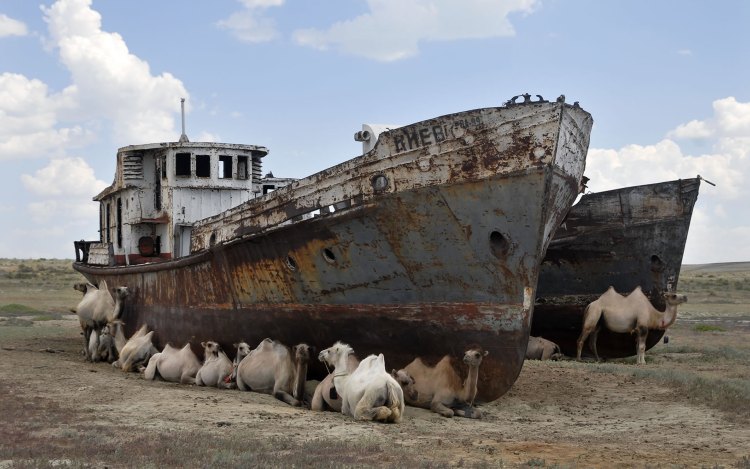
Beached ships in the dry Aral Sea
Beached fishing boats in the dry bed of the Aral Sea
To listen to the audio Podcast? CLICK HERE.

The Aral Sea is actually situated in Central Asia, between Northern Uzbekistan and Southern Kazakhstan.  Once the fourth largest freshwater lake in the world, the vanishing Aral Sea is nearly empty now, thanks to a decades-old, poorly-engineered, Soviet-begun desert irrigation program.

The Aral Sea once had a surface area of over 26,000 square miles (67,300 square km). It was circled with booming Kazak and Uzbek towns living off a thriving fishing industry of carp, flounder and catfish.  It provided over 40,000 jobs and supplied the entire Soviet Union with a sixth of its fish – but no more.

The Aral Sea is fed by two of Central Asia’s mightiest rivers, the Amu Darya and the Syr Darya, both originating in the snowy Himalayas to the south, before flowing north and crossing a desert to the Aral Sea. In the 1960s, the Soviet government, led by Nikita Khrushchev, decided to turn that vast desert steppe into new farmland, like southern California.  So over the next decade, they built an enormous irrigation network, including 45 dams, 80 reservoirs and 20,000 miles of canals.  All to irrigate the Kazakhstan and Uzbekistan desert, turning it into sprawling fields of cotton and wheat. 

But the Soviet system was very poorly engineered from the start. 

Much of the water meant for the Aral Sea leaked out of the canals and never made it’s journey north. So not only was water being diverted to farmland at the expense of the Sea, the majority was soaked up by the desert and wasted.  Under normal conditions, the Aral Sea gets about 1/5 of its water from rainfall, with the rest from those 2 big rivers. Evaporation caused the water level to decrease faster than the amount that trickled in, causing the sea to slowly dry up.

In the decades that followed, the Aral Sea was slowly starved of its water source and reduced to a handful of smaller lakes, with a volume 1/10 the original size. As a consequence, the salinity of those remaining lakes increased due to evaporation, causing almost all fish that either survived the shrinking, or salt-tolerant fish that had been reintroduced, in the 1990’s to die off.

As a result, millions of fish perished over the decades.  Coastlines receded miles and miles from the fishing towns, leaving boats to rust on the now dry sea bed.  Those few Kazak’s and Uzbek’s who remained were plagued by dust storms that contained the toxic fertilizers and pesticides used by the Soviets in the desert.  Large herds of antelope dependent on the sea vanished. Grown children of the fishermen abandoned the sea in search of city jobs elsewhere.

Where once you sailed from town to town, now you could drive across!

Fisheries and the villages that depended on them collapsed like Gold Rush ghost towns. The increasingly salty water became polluted with the dust blown fertilizer and pesticides. The salty dust also blew off the dry lake bed and settled onto farm fields, degrading the soil. Farmlands had to be flushed with greater volumes of river water to compensate.  It was a vicious cycle the Soviet government was unwilling to stop … and, since its fall in 1991, Uzbekistan has since continued.

Other dramatic consequences include the response by Mother Nature to man’s intervention.  The loss of such a large body of water made winters colder and summers drier.  The blowing contaminated dust from the exposed lake bed, became a public health hazard for the millions of people still in the region.  These include a rise in infant mortality rates, a decrease in over-all life expectancy, and an increase in kidney and liver disease, respiratory infections, and birth defects.

By the year 2000, the lake had separated into the smaller North Aral Sea in Kazakhstan and the larger South Aral Sea in Uzbekistan. The southern Sea had further split into western and eastern lung-shaped lobes as it continued to dry up, first in the eastern lobe, then the western one, like an organ with cancer. Moynaq harbor in Uzbekistan had a thriving fishing industry that employed thousands. Now it lies 90 km (56 mi) from the shrinking shore. Fishing boats lie abandoned on the dry sea bed, sitting there for over 20 years.

By 2001, the southern lobes’ water connection had been severed.  The shallower eastern part retreated rapidly when drought cut off the flow of the Amu Darya river completely.  In 2014, the eastern lobe of the South Aral Sea completely disappeared.  The remaining western lobe is a salty toxic turquoise instead of deep blue.  90% of the once massive lake is now gone.

Satellite images shows that the southern basin of the once huge lake is now almost dry.

The Aral Sea before (left image) and after (right image)
The Aral Sea before (left image) and after (right image) Soviet intervention

In a last-ditch effort to save the smaller north lake, Kazakhstan and the World Bank built a dam between the northern and southern parts of the Aral Sea. The Kok-Aral dam, finished in 2005, prevents flow out of the North Aral into the lower South Aral. The dam has led fisheries in the North Aral to rebound as water levels rose again, though to the detriment of the South Aral. Uzbekistan has left the South Aral Sea to its deadly fate and shows no sign of abandoning its overuse of the two Himalayan rivers for farm irrigation.  Instead, it has opened up the dry lake bed for foreign oil exploration and tourism.

What lessons does the human manipulation of the Aral Sea teach?  For the future, the difficulty lies in mankind being capable of predicting the ecological consequences of such massive projects before we undertake them. Our ecosystem is far more fragile than we think.  The current worsening climate change, with its decades-long global droughts, proves it. It must be the forefront of any such decision we make BEFORE we commit to such large scale actions.  For these profit-driven, well-intentioned, though ill-conceived projects too often result in even larger, deadly repercussions for planet Earth.

如需阅读历史作家保罗·安德鲁斯的更多作品,请点击书籍
主页 » 博客 » Page 20

Podcast: Castle Bravo – a Human-made Armageddon

On Monday March 1st, 1954, at 6:45 am, the U.S. carried out its largest nuclear detonation ever – CASTLE BRAVO – at the Bikini Atoll in the South Pacific Marshall Islands. Both military servicemen and Marshall Islanders got to experience first-hand what Armageddon would truly be like. The explosion turned out to be 2.5 times bigger than planned and caused far higher levels of radioactive fallout than ever predicted. Castle Bravo was the worst radiological disaster in American atomic history.

Above ground detonation of the Castle Bravo hydrogen bomb
Above ground detonation of the Castle Bravo hydrogen bomb in the South Pacific

Prefer to read the Blogpost instead?  CLICK HERE

The Forgotten Great Chinese Famine of 1959

Great Chinese Famine victims
Victims of the Great Chinese Famine

From 1959 to 1961, the Chinese people were decimated, not by a SARS or coronavirus, but by a devastating modern day famine. The death toll, concealed by the Communist government at the time, is still a matter of debate. The consensus however is that at least 30 million people died, though some estimates take it as high as 50 MILLION. The death toll is staggering,  greater than ALL the people killed in World War I. The root cause of the Chinese famine remains a taboo subject in the People’s Republic of China even 60 years later.

With its huge population and historically agricultural economy, China is no stranger to famines. Its food production is easily susceptible to droughts, floods, population growth, and wars.  The 3 year Great Chinese Famine of 1958-61 however, was deadlier than any in China’s long history. The causes and numbers of dead have long been hidden by the communists.  Though exacerbated by drought, the GCF was worsened by the strict actions of Chairman Mao and the government in Beijing.

According to the Chinese Communist Party, the GCF was caused by a string of natural disasters, referred to rather innocently as the “Three Years of Difficulties.” In 1959, the Yellow (Huang Ho) River massively flooded, causing ruined crops and thousands of deaths. Almost 100 million acres of farmland was destroyed.  The flood was followed by a severe drought, several typhoons, more flooding, and a plague of insects. In 1960, the prolonged drought caused crop failures in 6 provinces, cutting their food production by more than half.

China’s coastal and southern provinces also bore the brunt of those major typhoons. In 1961, the northern provinces suffered another drought, while the south endured more river flooding.  The bad weather and climate were fairly localized however. Only 10% of Chinese farmland was destroyed. While there is no doubt all these natural disasters had an impact on China’s agriculture, communist mismanagement and bad Maoist policies were far more responsible for the famine to come.

In 1959, Chairman Mao launched his “Great Leap Forward.”

This was a mass mobilization of China’s huge population to achieve, in just a few years, the economic growth it took the West decades to accomplish.  Mao Zedong believed Josef Stalin, who had stressed steel production was the key to national success. Peasants were forced to abandon private farming; and agricultural communes planted less grain. Tens of millions of peasants were ordered to mine iron ore, cut trees for charcoal, build clay furnaces, and make steel. This ill-conceived effort produced mostly brittle cast iron, unfit for even hand tools.

The population now ate in commune kitchens, pots and pans were confiscated, and much farming was simply stopped.  Local Chinese officials exaggerated the effects of those natural disasters in order to justify their low farm yields and appease the Beijing government. At the same time, provinces reported record grain hauls — greatly exaggerating their figures to meet the high government quotas.

Under Chairman Mao, Chinese farmers were required to give all their grain to the government. Some of this grain was then ‘redistributedback to the farmers as their food source. Most, however, was either sent to the biggest Chinese cities, like Shanghai and Beijing, or sold as exports to create the illusion of superior Red China policies.

With the state commandeering all the grain, peasant communes were left with not enough food of their own. Some communes didn’t ration, believing the government would simply send them the promised food relief.  That did not happen.  In reality, grain harvests plummeted due to the shift in manpower to steel production.  By 1959, food shortages outside the cities reached a critical point. Millions in the countryside began starving to death, with famine in a third of China’s provinces.

Chairman Mao then hid or ignored the failings of his own policies.

Mao’s response was to attack any critics, rather than solve the food problem. History was rewritten by the party and the truth covered up.  Taking away private farming, forcing peasants into communes, preferentially supplying food to large cities and continuing grain exports were all Communist Party acts.  To make matters worse, in never acknowledging the Great Chinese Famine, China’s rulers failed to ask for any foreign food aid.

In some communes, a third of the inhabitants die of painful starvation. Survivors are beaten by the military for refusing to hand over what little food they have, or for stealing from the government simply to survive. Millions of Chinese were dying of hunger.  Villages became ghost towns — no chickens, no dogs, even the trees were stripped of bark and eaten.  Those who complained, or tried to leave their province, were sent by the Communist Party to forced labor camps.

Without a doubt, the drought in 1960 didn’t help, but caused only a fraction of the nationwide famine. Meanwhile, in the countryside, the peasants starved. Many resorted to eating grass, leather, even sawdust and dirt. Dogs, cats, rats, mice and insects were all eaten until they too were gone.  The birth rate sank as malnourished women could not carry to term. Insanity and suicide became common place.  2.5 million people are believed to have taken their own lives out of desperation.

Overwhelming hunger made humans behave in desperate ways, including cannibalism.

Government records reported cases where people ate dead bodies and even fought over corpses.  Parents ate their own children. Children ate their parents. Cannibalism was punished by the authorities, but continued nonetheless.  There were also many cases of child abandonment and even child selling. Some starving parents killed their children or elderly relatives to relieve them of their misery.

Movement out of affected regions was banned by the military, while communications were cutoff or censored. The Communist Party arrested or killed those who sought to tell the truth. Propaganda posters celebrated Chairman Mao’s Great Leap Forward, showing bountiful harvests, happy peasants and fat livestock. The reality throughout China, of course, was very different.

No one imagined there was still grain sitting in the city warehouses, that the government was in fact still exporting. The Red China government concealed the famine, both from its own people and the world.  Food supplies in the large cities then began to dwindle, causing urban death rates to double.  Even these were attributed to the natural disasters.

Chinese peasants waiting for food distribution
Chinese famine peasants waiting for government food distribution

The Chinese government continued to export grain, sending 7 million tons offshore during the 3 famine years– an amount that could have saved 16 million Chinese lives. The International Red Cross offered food, but this was turned down by Beijing.  Only a return to more reasonable farming policies and food distribution after 1961, including importing desperately needed grain, finally ended the GCF.

At the time, the Great Chinese Famine was virtually ignored by the international press and politicians in the US and Europe.  Eyewitness stories of refugees who had fled to Hong Kong were dismissed and rarely reported during the 3 years of famine.  What are we to make of the Western indifference to the suffering of Red China’s population at the time?  Remember, this was at the height of the US-USSR super power Cold War.  And the Red Chinese were die hard Communists.

Today’s modern China is lightyears from Chairman Mao’s. 

It’s grown from its agricultural and military past into a technology and manufacturing superpower.  There is hope that new generations of Chinese leaders may be willing to revisit the country’s past and acknowledge the mistakes that were made. The archives of the Chinese Communist Party will hopefully someday be opened and yield those long hidden secrets. Even then, we will perhaps never know exactly how many millions of Chinese people perished due to starvation during those three terrible years of the great famine.

如需阅读历史作家保罗·安德鲁斯的更多作品,请点击书籍
主页 » 博客 » Page 20

Podcast: Ten Theories about the Never-Aging Count Saint Germain

So who exactly was le Comte de Saint-Germain, the never-aging man of mystery who left so few clues behind?  How could he hobnob around Europe throughout the 1700’s and never appear to grow old?  Count Saint Germain He looked the same in London in 1743 as he did in St. Peterburg in 1762, as he did Paris in 1789.  Was he a clever charlatan, a skilled alchemist, a royal spy, or perhaps … something more?  The answer lies in which theory and which source you trust.

Count Saint Germain portrait
Count Saint Germain 1784 portrait


Click here for The Man Who Would Not Die – a Count Saint Germain novel
主页 » 博客 » Page 20

Podcast: Typhoid Mary Mallon – Villain or Victim?

Over the past 100 years, Typhoid Mary’s name has became synonymous with any notorious carrier or spreader of an infectious disease, causing an epidemic or worse. But there was a real-life woman, Mary Mallon, and a tragic story behind that infamous name.  Who was she and how did Typhoid Mary become so notorious?

Depiction of Typhoid Mary Mallon
Newspaper depiction of Typhoid Mary Mallon
Prefer to read a Blogpost instead?  CLICK HERE

主页 » 博客 » Page 20

Podcast: Who Drained Russia’s Vast Aral Sea?

To answer the question, it was the Soviet Union, that’s who.  The Aral Sea is actually situated in Central Asia, between Northern Uzbekistan and Southern Kazakhstan.  Once the fourth largest freshwater lake in the world, the vanishing Aral Sea is now nearly empty, thanks to a flawed, decades-old, Soviet-engineered desert irrigation program.

Beached ships in the dry Aral Sea
To read the blog post  CLICK HERE

播客:1918年西班牙流感超越黑死病以来的所有大流行病

Before COVID, before Ebola, before SARS, the 1918 Flu Pandemic killed more humans than all of World War I combined, over 50 million people worldwide!  In just over a year, the so-called ‘Spanish Flu’ would infect a fifth of the world’s population. It remains to this day THE most devastating pandemic in recorded history.

A makeshift hospital for Spanish Flu victims in 1918

Prefer to read a Blog Post instead?  CLICK HERE


主页 » 博客 » Page 20